

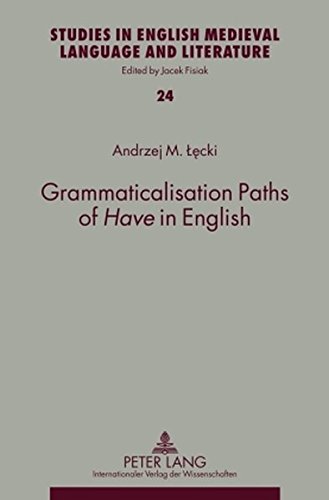
Grammaticalisation Paths of Have in English 1st Edition by Andrzej Łęcki ISBN 9783631600276 3631600275

Original price was: $50.00.$35.00Current price is: $35.00.
Grammaticalisation Paths of Have in English 1st Edition by Andrzej M. Łęcki – Ebook PDF Instant Download/Delivery: 9783631600276, 3631600275
Full download Grammaticalisation Paths of Have in English 1st Edition after payment
Product details:
ISBN 10: 3631600275
ISBN 13: 9783631600276
Author: Andrzej M. Łęcki
Table of contents:
Chapter One: Grammaticalization theory
1 Introduction
2 The history of grammaticalisation
2.1 From syntax to morphology – Givón.
2.2 Cologne project
2.2.1 Lehmann’s analysis
2.2.2 Heine and Reh’s analysis.
2.3 Hopper’s proposals
2.4 Traugott’s pragmatic approach
3 Recent studies on grammaticalisation.
4 The term grammaticalisation
5 Motivation for and mechanisms of grammaticalisation.
5.1 Morphosyntactic changes.
5.2 Pragmatic-semantic changes
5.2.1 Semantic content a gain or loss?..
5.2.2 Metaphorisation – metonymisation vs. analogy – reanalysis
5.3 Phonetic changes.
5.4 Gradualness.
Unidirectionality hypothesis and its criticism.. 6
7 Clines and paths of grammatical change..
8 Criticism of grammaticalisation.
Chapter Two: Semanticisation of HAVE
1 Chapter outline.
2 Earliest phonological development of HAVE.
3 Desemanticisation of HAVE…..
3.1 Is there bread? It hasn’t. Some cross-linguistic evidence
3.2 The rise of the HAD BETTER structure.
4 Summary and conclusion.
Chapter Three: Along the possession-to-obligation cline
Introduction. 1
2 Synchronic characteristics of HAVE TO.
3 Traditional accounts of the development of HAVE TO
4 The rise of HAVE TO viewed as a syntactically driven change
5 Grammaticalisation of HAVE TO revised..
5.1 The auxiliary status of HAVE TO in Old English.
5.2 Latin influence…
5.3 Word order of HAVE + to-infinitive
5.4 Pragmatic-semantic development of HAVE TO
5.5 Negation of HAVE TO
5.6 Discussion
6 (HAVE) GOT TO.
7 Summary
Chapter Four: Possessive Perfect
4.1 Chapter outline.
4.2 Traditional views on the rise of possessive perfect
4.3 The rise of ‘have’-perfect in English
4.3.1 Stages of the development
4.3.2 AGAN + past participle
4.3.3 BEON vs. HABBAN + past participle
4.4 Functions and status of HABBAN + PPP in Old English.
4.4.1 Some differences between OE and PDE perfect
4.4.2 The level of grammaticalisation of HABBAN + PPP structure.
4.4.3 Similarities between Old and Present-Day English perfect
4.4.4 Carey’s (1994), (1995) analyses.
4.4.5 Perfect infinitive in Old English.
4.5 Causative HAVE
4.6 Summary
People also search for:
grammaticalisation paths
grammaticalization paths
path as a verb
path.resolve example
path ideas