

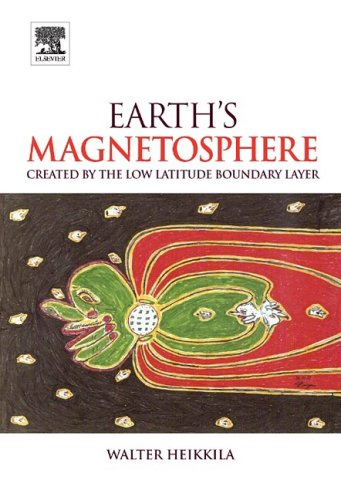
Earth’s Magnetosphere Formed by the Low Latitude Boundary Layer 1st Edition by Heikkila ISBN

Original price was: $50.00.$35.00Current price is: $35.00.
Earth’s Magnetosphere Formed by the Low Latitude Boundary Layer 1st Edition by Heikkila – Ebook PDF Instant Download/Delivery: 0444528644, 978-0444528643
Full download Earth’s Magnetosphere Formed by the Low Latitude Boundary Layer 1st edition after payment
Product details:
ISBN 10: 0444528644
ISBN 13: 978-0444528643
Author: Heikkila
The author argues that, after five decades of debate about the interactive of solar wind with the magnetosphere, it is time to get back to basics. Starting with Newton’s law, this book also examines Maxwell’s equations and subsidiary equations such as continuity, constitutive relations and the Lorentz transformation; Helmholtz’ theorem, and Poynting’s theorem, among other methods for understanding this interaction.
- Includes chapters on prompt particle acceleration to high energies, plasma transfer event, and the low latitude boundary layer
- More than 200 figures illustrate the text
- Includes a color insert
Earth’s Magnetosphere Formed by the Low Latitude Boundary Layer 1st Table of contents:
Chapter 1 – Historical introduction
1.1 Early history
1.2 International Geophysical Year (IGY)
1.3 International Magnetospheric Study
1.4 Electric and magnetic fields in space
1.5 Reference frames and frozen fields
1.6 Coronal expansion
1.7 Solar wind
1.8 Magnetosheath
1.9 Magnetopause
1.10 Cause and effect at the magnetopause
1.11 Low-Latitude Boundary Layer
1.12 Discovery of the radiation belt
1.13 The ionosphere
1.14 High frequency wave propagation
1.15 Polar cap during southward Interplanetary Magnetic Field (IMF)
1.16 The aurora and substorms
1.17 Discussion
Chapter 2 – Approximate methods
2.1 Need for approximate methods
2.2 Circuit analysis
2.3 Basic magnetohydrodynamic equations
2.4 Example of MHD for magnetospheric research
2.5 Discussion
2.6 Summary
Chapter 3 – Helmholtz’s theorem
3.1 Introduction
3.2 Helmholtz’s theorem
3.3 Maxwell’s equations
3.4 Gauss’s law
3.5 Gauge conditions
3.6 Electrodynamics
3.7 Sporadic magnetopause beams
3.8 Particle simulation in 1-D
3.9 Exceptional electron beam observation
3.10 Other observations of energisation
3.11 Discussion
3.12 Summary
Chapter 4 – Poynting’s energy conservation theorem
4.1 Introduction
4.2 The electric displacement: D field
4.3 The magnetic field H
4.4 Poynting’s theorem
4.5 Discussion
4.6 Plasma transfer event seen by Cluster
4.7 Three systems
4.8 Scientific paradigms
4.9 Summary
Chapter 5 – Magnetopause
5.1 Introduction
5.2 Solar wind – magnetopause interaction
5.3 ISEE observations
5.4 Profile of magnetopause electron temperature
5.5 Impulsive penetration
5.6 Flux transfer event
5.7 Cluster observations of plasma transfer
5.8 Plasma transfer event
5.9 Skimming orbit of GEOTAIL
5.10 Electric field at high sampling rates
5.11 Discussion
5.12 Summary
Chapter 6 – High-altitude cusps
6.1 Introduction
6.2 The magnetosheath
6.3 The cusp throat
6.4 Transfer events
6.5 Cusp energetic particles
6.6 Exterior cusp
6.7 Discussion
6.8 Summary
Chapter 7 – Low-latitude boundary layer
7.1 Introduction
7.2 Comprehensive investigation of low-latitude boundary layer
7.3 Studies with better resolution
7.4 Plasma transfer event
7.5 Identification of cusp and cleft/low-latitude boundary layer
7.6 Qualitative description of low-latitude boundary layer
7.7 Topology of the magnetosphere
7.8 ISEE observations
7.9 Transient penetration
7.10 Massive flow in the boundary layer
7.11 Other observations of the low-latitude boundary layer
7.12 Polar cap during southward interplanetary magnetic field
7.13 Study with southward interplanetary magnetic field
7.14 Polar cap during northward interplanetary magnetic field
7.15 Penetration of interplanetary electric field into magnetosphere
7.16 A study with northward interplanetary magnetic field
7.17 Discussion
7.18 Summary
Chapter 8 – Driving the plasma sheet
8.1 Introduction
8.2 Transfer of plasma and electric field
8.3 Plasma sheet from low altitude observations
8.4 Plasma sheet observations
8.5 Particle dynamics
8.6 Auroral current circuit
8.7 Key results from SuperDARN, CANOPUS
8.8 Large scale flow dynamics
8.9 Discussions
8.10 Summary
Chapter 9 – Magnetospheric substorms
9.1 Introduction
9.2 Statistical description of the substorm
9.3 Two models as apparent alternatives
9.4 Substorm disturbance onsets
9.5 Substorm transfer event
9.6 Ion dynamics
9.7 Westward travelling surge
9.8 Bursty bulk flows
9.9 Observations of particle acceleration
9.10 Acceleration of cold plasma
9.11 Discussion
9.12 Summary
Chapter 10 – Epilogue: What is new in this book
10.1 Introduction
10.2 Main arguments in this book
10.3 Substorm transfer event
10.4 Four fundamental processes reexamined
10.5 Final summary
People also search for Earth’s Magnetosphere Formed by the Low Latitude Boundary Layer 1st :
earth’s magnetosphere is formed as a result of what
how is earth’s magnetosphere formed
how is earth’s magnetosphere generated
what is the major cause of the earth’s magnetosphere
what is earth’s magnetosphere
Tags: Heikkila, Earth’s Magnetosphere, the Low