

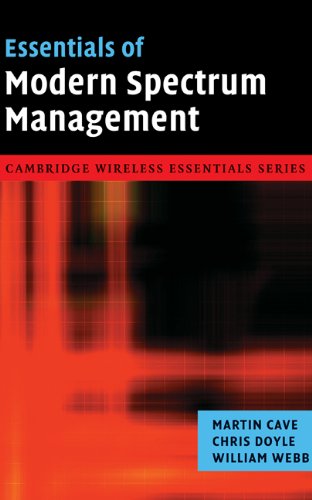
Essentials of Modern Spectrum Management The Cambridge Wireless Essentials Series 1st Edition by Martin Cave, Chris Doyle, William Webb ISBN 0521208491 978-0521208499


Original price was: $50.00.$35.00Current price is: $35.00.
Essentials of Modern Spectrum Management The Cambridge Wireless Essentials Series 1st Edition by Martin Cave, Chris Doyle, William Webb – Ebook PDF Instant Download/Delivery: 0521208491, 978-0521208499
Full download Essentials of Modern Spectrum Management The Cambridge Wireless Essentials Series 1st edition after payment
Product details:
ISBN 10: 0521208491
ISBN 13: 978-0521208499
Author: Martin Cave, Chris Doyle, William Webb
Are you fully up-to-speed on today’s modern spectrum management tools? As regulators move away from traditional spectrum management methods, introduce spectrum trading and consider opening up more spectrum to commons, do you understand the implications of these developments for your own networks? This 2007 book was the first to describe and evaluate modern spectrum management tools. Expert authors offer insights into the technical, economic and management issues involved. Auctions, administrative pricing, trading, property rights and spectrum commons are all explained. A series of real-world case studies from around the world is used to highlight the strengths and weaknesses of the various approaches adopted by different regulators, and valuable lessons are drawn from these. This concise and authoritative resource is a must-have for telecom regulators, network planners, designers and technical managers at mobile and fixed operators and broadcasters, and academics involved in the technology and economics of radio spectrum.
Essentials of Modern Spectrum Management The Cambridge Wireless Essentials Series 1st Table of contents:
I Emerging problems with the current spectrum management approach
1 Current spectrum management methods and their shortcomings
1.1 Why spectrum needs to be managed
1.2 The current management mechanisms
1.3 Shortcomings of the current system
1.4 Alternative management approaches
1.5 How this book addresses the new approaches
Reference
2 How changing technology is impacting spectrum management
2.1 Technology used to lend itself to discrete allocations
2.2 Multi-modal radios
2.3 Cognitive and software defined radios
2.3.1 Introduction
2.3.2 The progress of technology
2.3.3 The implications of cognitive radios
2.3.4 The problems with cognitive radios
2.3.5 The likely outcome for spectrum management
2.4 Ultra-wideband
2.4.1 Introduction
2.4.2 Technological issues
2.4.3 Current international position
2.4.4 The likely outcome for spectrum management
2.5 Summary
3 Alternative ways of dividing spectrum
3.1 Spectrum has been divided by frequency
Exclusive access
Geographical sharing
Band sharing
3.2 UWB raises the possibility of division by power
3.2.1 Interference temperature
3.3 Other divisions are also possible
Time
Angle
Polarisation
3.4 Summary: in practice, changes to spectrum division would be minor
II Markets
4 Market solutions
4.1 Introduction
4.2 Market methods
4.3 Market failures
4.4 Conclusion
5 Auctions
5.1 Introduction
5.2 Auctions versus administrative methods of assignment
5.3 Theory of auctions
5.4 Auction formats
5.4.1 Auction format options
5.5 Auction logistics
5.5.1 The invitation stage
5.5.2 Pre-qualification stage
5.5.3 Auction stage: designing the rules
5.5.4 The grant stage
5.6 Conclusion
References
6 Spectrum trading: secondary markets
6.1 Introduction
6.2 Radio spectrum and market forces
6.3 Spectrum trading, markets and efficiency
6.3.1 Thick markets
6.3.2 No market power
6.3.3 Well-defined property rights
6.3.4 Full information
6.4 Objections to spectrum trading
6.4.1 Lack of harmonisation
6.4.2 Windfall profits
6.5 The implementation of spectrum trading in the UK
6.6 Trading in other countries
6.6.1 New Zealand
6.6.2 United States of America
6.6.3 Australia
6.6.4 Guatemala
6.6.5 European Union
6.7 Conclusion
References
7 Technical issues with property rights
7.1 Introduction
7.2 Key elements of property rights
7.2.1 Out-of-band power
7.2.2 In-band power
7.3 The problem of deployment density
7.4 Calculating noise floor levels
7.5 Making a property rights system work in practice
7.5.1 Setting the initial terms
7.5.2 How a licence holder determines what network they can deploy
7.5.3 Negotiation as a mechanism for changing rights
7.5.4 Shared bands and guard bands
7.6 UWB and property rights
7.7 Managing interference
7.8 A detailed look at the definition of property rights
7.8.1 An example case
Downlink
Uplink
7.9 Summary
References
8 Economic issues with property rights
8.1 Creating property rights: economic aspects
8.2 Principles for the allocation of property rights
8.3 Underlays and overlays
8.4 Defining property rights for spectrum: commercial and economic issues
8.4.1 Leasehold or freehold?
8.4.2 Can encumbered spectrum licences be traded?
8.4.3 Should vacant spectrum be sold?
8.4.4 Dealing with the hold-out problem
8.4.5 Should spectrum licensees pay an annual charge to the state?
8.4.6 Should property rights in the transition to a market regime be limited to avoid windfall gains
8.5 Conclusion
References
9 Competition issues relating to spectrum
9.1 Introduction
9.2 Competition issues in a command-and-control regime
9.3 Competition issues under a market regime for spectrum management
9.4 Spectrum caps
9.5 Conclusions
10 Band management
10.1 Introduction
10.2 Types of band manager
10.3 Fundamentals of band management
10.3.1 Band managers need to use the spectrum more efficiently
10.3.2 Planning and technology are the most likely routes to greater efficiency
10.3.3 Advanced technologies
10.4 The business case for band management
10.4.1 Introduction
10.4.2 Private mobile radio
10.4.3 Fixed links
10.4.4 Unrestricted access or “private commons”
10.4.5 Summary of cases
10.4.6 Band managers and competition issues
10.5 Summary and conclusions
Reference
III Regulation
11 Incentive based spectrum prices: theory
11.1 Introduction
11.2 Economic efficiency and radio spectrum
11.3 Productive efficiency and radio spectrum
11.4 Pricing radio spectrum to achieve economic efficiency
11.5 The Smith-NERA method of calculating spectrum prices
11.6 Setting spectrum prices to achieve efficiency using the Smith-NERA method
11.6.1 Setting the spectrum price: using judgement
11.6.2 Comments
11.7 The interaction between spectrum pricing and spectrum trading
11.7.1 Introducing trading
11.7.2 Asymmetry of risk in setting AIP
11.7.3 Economic benefits and costs associated with trading and AIP
11.7.4 Should observed traded prices inform AIP?
11.8 Conclusion
References
12 Incentive based spectrum pricing: practicalities
12.1 Introduction
12.2 Applying administrative incentive prices: some issues
12.2.1 Calculating opportunity costs
12.2.2 Assumptions
What is the appropriate size of a marginal change in radio spectrum?
What is meant by an average or reasonably efficient user?
What is the appropriate discount rate and discounting period?
How should equipment maintenance costs be assessed?
How does one reflect the maturity of existing networks in the calculations?
12.2.3 Congestion and area sterilised
12.3 Calculating AIP in practice: case study of fixed links in the UK
12.3.1 Introduction
12.3.2 Setting AIP for fixed links in the UK: a case study
12.4 Incentive based spectrum charges in other countries
12.4.1 Australia
12.4.2 Canada and Denmark
12.5 Conclusion
References
13 How the commons works
13.1 Introduction
13.2 The economics of the commons
13.2.1 Case 1: a single output
13.2.2 Case 2: competing outputs
13.2.3 Case 3: multiple bands
13.2.4 Case 4: growing or uncertain demand
13.2.5 Case 5: regulation of use of the commons
13.2.6 Case 6: indirect revenue generation from unlicensed spectrum
13.2.7 Implementing the net benefit calculation
13.3 The likelihood of congestion in radio spectrum
13.3.1 Introduction
13.3.2 Key factors which lead to congestion
Mesh networks
13.3.3 Spectrum commons is unlikely to significantly alleviate congestion
Efficiency of use
Differing demand patterns
13.3.4 In unlicensed bands, regulatory rules have an impact on the level of congestion
13.3.5 Conclusions
13.4 Quasi-commons: UWB and cognitive radio
13.5 Summary
References
14 Commons or non-commons?
14.1 Introduction
14.2 The use of market mechanisms to determine the amount of spectrum commons
14.3 The “total spectrum needed” approach
14.4 The “band-by-band” approach
14.4.1 Introduction
14.4.2 Consultation
14.4.3 Economic assessment
14.4.4 Examine similar bands and uses
14.4.5 Decide whether to make the band unlicensed
14.4.6 An alternative
14.4.7 Deciding on regulatory restrictions
14.5 Summary
15 Is public sector spectrum management different?
15.1 Introduction
15.2 Is public sector spectrum special?
15.3 Intermediate steps to encourage efficiency in public sector spectrum use
15.4 Public sector incentive problems
15.5 Conclusions
References
16 Are developing countries different?
16.1 Introduction
16.2 Consequences for spectrum management
16.3 Conclusion
References
IV Conclusions
17 Conclusions
17.1 A reminder of the problem
17.2 Key conclusions
17.3 In summary
People also search for Essentials of Modern Spectrum Management The Cambridge Wireless Essentials Series 1st:
essentials of modern communications
essentials with spectrum
spectrum essential
mcgraw hill essentials of contemporary management
the essential spectrum
Tags: Martin Cave, Chris Doyle, William Webb, Modern Spectrum, The Cambridge