

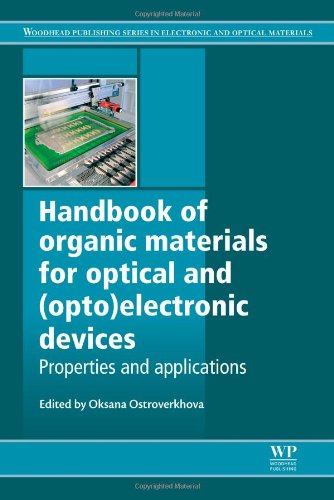
Handbook of Organic Materials for Optical and Opto Electronic Devices Properties and Applications 1st Edition by Oksana Ostroverkhova 9780857092656 0857092650


Original price was: $50.00.$35.00Current price is: $35.00.
Handbook of Organic Materials for Optical and Opto Electronic Devices Properties and Applications 1st Edition by Oksana Ostroverkhova – Ebook PDF Instant Download/Delivery: 9780857092656, 0857092650
Full download Handbook of Organic Materials for Optical and Opto Electronic Devices Properties and Applications 1st Edition after payment
Product details:
ISBN 10: 0857092650
ISBN 13: 9780857092656
Author: Oksana Ostroverkhova
Parts one and two explore the materials used for organic optoelectronics and nonlinear optics, their properties, and methods of their characterization illustrated by physical studies. Part three moves on to discuss the applications of optoelectronic and nonlinear optical organic materials in devices and includes chapters on organic solar cells, electronic memory devices, and electronic chemical sensors, electro-optic devices.
The Handbook of organic materials for optical and (opto)electronic devices is a technical resource for physicists, chemists, electrical engineers and materials scientists involved in research and development of organic semiconductor and nonlinear optical materials and devices.
- Comprehensively examines the properties of organic optoelectric and nonlinear optical materials
- Discusses their applications in different devices including solar cells, LED’s and eletronic memory devices
- An essential technical resource for physicists, chemists, electrical engineers and materials scientists
Table of contents:
Chapter 1: Small Molecular Weight Materials for (Opto)Electronic Applications: Overview
1.1 Introduction
1.2 Historical Development in Organic (Opto)Electronics: Devices and Materials
1.3 Photo and Electroactive Organic Materials: Organic π-Electron Systems
1.4 Organic (Opto)Electronic Devices: Principles and Operation Processes
1.5 Molecular Materials for Organic (Opto)Electronic Devices
1.6 Structures and Performance of Organic (Opto)Electronic Devices
1.7 Conclusion and Future Trends
Chapter 2: Influence of Film Morphology on Optical and Electronic Properties of Organic Materials
2.1 Introduction
2.2 Discontinuous Processing
2.3 Continuous Processing
2.4 Conclusion
Chapter 3: Doping Effects on Charge Transport in Organic Materials
3.1 Introduction
3.2 Basics of Doping of Organic Semiconductors
3.3 Doped Organic p-i-n Devices
3.4 Conclusion and Future Trends
3.5 Acknowledgements
3.6 Appendix: Compound Abbreviations, Full Names, and CAS Numbers
Chapter 4: Third-Order Nonlinear Optical Properties of π-Conjugated Polymers with Thiophene Units and Molecular Assembly of the Polymers
4.1 Introduction
4.2 Third-Order Nonlinear Optical Properties of π-Conjugated Polymers with Thiophene Units and Related Compounds
4.3 Packing and Molecular Assembly of π-Conjugated Polymers
4.4 Conclusions and Future Trends
4.5 Acknowledgments
Chapter 5: Small Molecule Supramolecular Assemblies for Third-Order Nonlinear Optics
5.1 Introduction
5.2 Fundamental Principles of the Third-Order Nonlinear Optical Response
5.3 Macroscopic Susceptibilities and Microscopic Polarizabilities
5.4 From Molecules to Bulk Solid-State Materials
5.5 Small Molecules with Large Third-Order Nonlinearities
5.6 Small Molecule Supramolecular Assemblies with High Optical Quality and Large Third-Order Susceptibility
5.7 Conclusion
Chapter 6: Molecular Crystals and Crystalline Thin Films for Photonics
6.1 Introduction
6.2 Second-Order Nonlinear Optical Organic Crystals
6.3 THz-Wave Generation and Detection with Organic Crystals
6.4 Integrated Electro-Optic Applications
6.5 Conclusions and Future Trends
Chapter 7: Charge Generation and Transport in Organic Materials
7.1 Introduction
7.2 Theoretical and Computational Framework
7.3 Single-Molecule Magnitudes
7.4 Supramolecular Organization of the Samples
7.5 Predicting Relative and Absolute Values of Mobilities
7.6 From p-Type to n-Type Semiconductors
7.7 Conclusion
7.8 Acknowledgements
Chapter 8: Optical, Photoluminescent, and Electroluminescent Properties of Organic Materials
8.1 Introduction
8.2 Electronic States of Single Molecule and Molecular Solid State
8.3 Absorption and Emission Spectroscopy
8.4 Excitonic Processes
8.5 Electroluminescence in Organic Materials
8.6 Conclusion and Future Trends
Chapter 9: Nonlinear Optical Properties of Organic Materials
9.1 Introduction
9.2 Nonlinear Optics at the Molecular Level
9.3 From Microscopic (Molecules) to Macroscopic (Materials)
9.4 Quantum Mechanical Expressions for Molecular (Hyper)Polarizabilities
9.5 Conclusion and Future Trends
Chapter 10: Ultrafast Intrachain Exciton Dynamics in π-Conjugated Polymers
10.1 Introduction
10.2 Ultrafast Dynamics in π-Conjugated Polymers
10.3 Conclusion
Chapter 11: Ultrafast Charge Carrier Dynamics in Organic (Opto)Electronic Materials
11.1 Introduction
11.2 Infrared-Active Vibrational Modes
11.3 Transient Photocurrent Spectroscopy
11.4 Time-Resolved Terahertz Spectroscopy
11.5 Time-Resolved Microwave Conductivity
11.6 Experimental Evidence of Charge Localization
11.7 Conclusion
Chapter 12: Short-Pulse Induced Photocurrent and Photoluminescence in Organic Materials
12.1 Introduction
12.2 Photocurrent Response after Short-Pulse Excitation
12.3 Exciton Dynamics and Photoluminescence in Organic Molecular Crystals
12.4 Exciton Dynamics and Delayed Photocurrent
12.5 Conclusion
Chapter 13: Conductivity Measurements of Organic Materials Using Field-Effect Transistors (FETs) and Space-Charge-Limited Current (SCLC) Technique
13.1 Introduction
13.2 Field-Effect Transistor Measurements
13.3 Space-Charge-Limited Current Measurements
13.4 Future Trends
Chapter 14: Charge Transport Features in Disordered Organic Materials Measured by TOF, XTOF, and CELIV Techniques
14.1 Introduction
14.2 Measurement Techniques
14.3 Experimental Results of Charge Carrier Mobility Determination
14.4 Charge Transport Models in Disordered Organic Semiconductors
14.5 Conclusion
Chapter 15: Surface Enhanced Raman Scattering (SERS) Characterization of Metal–Organic Interactions
15.1 Introduction
15.2 SERS Background
15.3 SERS Applications
15.4 Control of SERS Signals
15.5 Conclusion
Chapter 16: Second Harmonic Generation as a Characterization Technique and Phenomenological Probe for Organic Materials
16.1 Introduction
16.2 SHG in Bulk Media
16.3 Electric Field Induced Second Harmonic Generation
16.4 Hyper-Rayleigh Scattering
16.5 SHG Probing Structure and Dynamics
16.6 Conclusion
16.7 Acknowledgments
Chapter 17: Organic Solar Cells (OSCs)
17.1 Introduction
17.2 Device Principles and Structures
17.3 Materials
17.4 Roll-to-Roll Processing
17.5 Demonstration Projects and Conclusion
17.6 Acknowledgments
Chapter 18: Organic Light-Emitting Diodes (OLEDs)
18.1 Introduction
18.2 Basics of OLEDs
18.3 Pin OLEDs
18.4 Highly Efficient Monochrome OLEDs
18.5 Highly Efficient White OLEDs
18.6 Degradation of OLEDs
18.7 Future Trends
Chapter 19: Organic Spintronics
19.1 Introduction
19.2 Magneto-Conductance and Magneto-Electroluminescence in OLEDs
19.3 Organic Spin-Valves
19.4 Optically Detected Magnetic Resonance in Poly(DOO-PPV)
19.5 Conclusion
19.6 Acknowledgments
Chapter 20: Organic Semiconductors for Electronic Chemical Sensors
20.1 Introduction
20.2 Sensitive OSC Devices
20.3 Sensitive Carbon Nanotube and Graphene Devices
20.4 Conclusion
20.5 Acknowledgments
Chapter 21: Organic Bioelectronics
21.1 Introduction
21.2 Organic Electrochemical Transistors
21.3 Enzymatic Sensing with OECTs
21.4 Cell-Based OECTs
21.5 Conclusions and Future Trends
Chapter 22: Organic Electronic Memory Devices
22.1 Introduction
22.2 Memory Types
22.3 Resistive Memory
22.4 Organic Flash Memory
22.5 Ferroelectric Random Access Memory
22.6 Molecular Memories
22.7 Future Trends
22.8 Sources of Further Information
22.9 Acknowledgment
Chapter 23: Unconventional Molecular Scale Logic Devices
23.1 Introduction
23.2 Nanoparticles and Their Applications in Molecular Scale Logic Devices
23.3 Photoelectrochemical Photocurrent Switching Effect
23.4 Logic Devices Based on PEPS Effect
23.5 Conclusions and Future Trends
23.6 Acknowledgments
Chapter 24: Photorefractive Polymers and Their Recent Applications
24.1 Introduction
24.2 Fundamentals of Photorefractivity
24.3 Functions of Photorefractive Components
24.4 Characterization Techniques
24.5 Photorefractive Polymer Composites for Applications
24.6 Conclusion and Future Trends
Chapter 25: Organic Waveguides, Ultra-Low Loss Demultiplexers, and Electro-Optic Polymer Devices
25.1 Introduction and Motivation
25.2 General Polymer Science
25.3 Polymer Processing
25.4 Ultra-Low Loss Polymer Waveguide Devices
25.5 Fabrication and Process-Induced Losses
25.6 Perfluoropolymer-Based True Time Delay Modules
25.7 High-Resolution Arrayed Waveguide Grating
25.8 Electro-Optical Polymer Waveguide Devices
25.9 Molecular Theory of Electro-Optic Polymers
25.10 Electric-Field Assisted Poling
25.11 Device and System-Level Analysis
25.12 Electro-Optic Polymer Spatial Light Modulators: Theory
25.13 Design and Fabrication
25.14 Device Characterization
25.15 Future Design Considerations
25.16 Conclusion
People also search:
handbook of optical materials
handbook of optical engineering
handbook of optical systems
handbook of optical constants of solids
handbook of optics
Tags: Oksana Ostroverkhova, Organic, Materials, Optical