

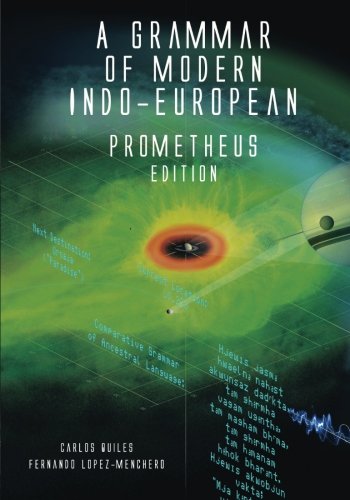
A Grammar of Modern Indo European Prometheus 1st Edition by Carlos Quiles, Fernando Lopez Menchero ISBN 148004976X 978-1480049765
Original price was: $50.00.$35.00Current price is: $35.00.
A Grammar of Modern Indo European Prometheus 1st Edition by Carlos Quiles, Fernando Lopez-Menchero – Ebook PDF Instant Download/Delivery: 148004976X, 978-1480049765
Full download A Grammar of Modern Indo European Prometheus 1st Edition after payment
Product details:
ISBN 10: 148004976X
ISBN 13: 978-1480049765
Author: Carlos Quiles, Fernando Lopez-Menchero
Table of contents:
1. INTRODUCTION.
1.1. THE INDO-EUROPEAN LANGUAGE FAMILY
1.2. TRADITIONAL VIEWS
1.3. THE THEORY OF THE THREE STAGES.
1.4. THE PROTO-INDO-EUROPEAN URHEIMAT.
1.5. OTHER ARCHAEOLINGUISTIC THEORIES.
1.6. RELATIONSHIP TO OTHER LANGUAGES
1.7. INDO-EUROPEAN DIALECTS
Schleicher’s Fable: From PIE to Modern English
1.7.1. Northern Indo-European dialects.
1.7.2. Southern Indo-European Dialects.
1.7.3. Anatolian Languages.
1.7.4. Prometheus’ Ancestral Language.
2. PHONOLOGY.
2.1. CLASSIFICATION OF SOUNDS.
2.2. PRONUNCIATION
2.3. SYLLABLES
2.4. PROSODY.
2.5. ACCENT.
2.6. VOWEL CHANGE
3. WORDS AND THEIR FORMS.
3.1. THE PARTS OF SPEECH.
3.2. INFLECTION
3.3. ROOT AND STEM.
3.4. GENDER
3.5. NUMBER
4. NOUNS..
4.1. DECLENSION OF NOUNS.
4.2. FIRST DECLENSION
4.2.1. First Declension Paradigm
4.2.2. First Declension in Examples.
4.2.3. The Plural in the First Declension
4.3. SECOND DECLENSION
4.3.1. Second Declension Paradigm.
4.3.2. Second Declension in Examples.
4.5.3. The Plural in the Second Declension..
4.4. THIRD DECLENSION
4.4.1. Third Declension Paradigm
4.4.2. In i, u..
4.4.3. In Diphthong..
4.4.4. The Plural in the Third and Fourth Declension
4.5. FOURTH DECLENSION
4.5.1. Fourth Declension Paradigm.
4.5.2. In Occlusive, m, 1.
4.5.3. In r, n, s….
4.5.4. The Plural in the Fourth Declension.
4.6. VARIABLE NOUNS.
4.7 . INFLECTION TYPES.
Excursus: Nominal Accent-Ablaut Patterns
4.8. NUMBER DEVELOPMENTS: THE DUAL
5 . ADJECTIVES.
5.1. INFLECTION OF ADJECTIVES
5.2. THE MOTION..
5.3. ADJECTIVE SPECIALISATION
5.4. COMPARISON OF ADJECTIVES
5.5. NUMERALS.
5.5.1. Classification of Numerals.
5.5.2. Cardinals and Ordinals
5.5.3. Declension of Cardinals and Ordinals
5.5.4. Distributives
5.5.5. Numeral Adverbs
5.5.6. Multiplicatives.
6. PRONOUNS.
6.1. ABOUT THE PRONOUNS
6.2. PERSONAL PRONOUNS.
6.3. REFLEXIVE PRONOUNS.
6.4. POSSESSIVE PRONOUNS.
6.5. ANAPHORIC PRONOUNS
6.6. DEMONSTRATIVE PRONOUNS
6.7. INTERROGATIVE AND INDEFINITE PRONOUNS
6.7.1. Introduction
6.7.2. Compounds
6.7.3. Correlatives
6.8. RELATIVE PRONOUNS
6.9. OTHER PRONOUNS
7. VERBS..
7.1. INTRODUCTION.
7.1.1. Voice, Mood, Tense, Person, Number.
7.1.2. Voice
7.1.3. Moods.
7.1.4. Aspect.
7.1.5. Tenses of the Finite Verb
7.2. FORMS OF THE VERB
7.2.1. The Verbal Stems
7.2.2. Verb-Endings
7.2.3. The Thematic Vowel.
7.3. THE CONJUGATIONS
7.4. THE FOUR STEMS..
7.4.1. Tense-Stems and Verb Derivation
7.4.2. The Present Stem
7.4.3. The Aorist Stem..
7.4.4. The Perfect Stem.
7.5. MOOD STEMS..
7.7. NOUN AND ADJECTIVE FORMS..
7.8. CONJUGATED EXAMPLES
7.8.1. Thematic Verbs.
7.8.2. Athematic Inflection.
7.8.3. Common PIE Stems
7.9. VERBAL COMPOSITION
7.10. THE VERBAL ACCENT.
8. PARTICLES.
8.1. PARTICLES
8.2. ADVERBS
8.3. DERIVATION OF ADVERBS
8.4. PREPOSITIONS.
8.5. CONJUNCTIONS
8.6. INTERJECTIONS
9. MORPHOSYNTAX.
9.1. VERBAL MORPHOSYNTAX
9.1.1. Person..
9.1.2. Tense-Aspect and Mood..
9.1.3. Voice.
9.2. NOMINAL MORPHOSYNTAX
9.2.1. Nominative.
9.2.2. Vocative.
9.2.3. Accusative.
9.2.4. Instrumental.
9.2.5. Dative
9.2.6. Ablative.
A 9.2.7. Genitive
Gc
928 Locative
9.2.9. Case Forms: Adverbial Elements.
10. SENTENCE SYNTAX.
10.1. THE SENTENCE..
10.1.1. Kinds of Sentences.
10.1.2. Nominal Sentence.
10.1.3. Verbal Sentence
10.2. SENTENCE MODIFIERS.
10.2.1. Intonation Patterns
10.2.2. Sentence Delimiting Particles.
10.3. VERBAL MODIFIERS
10.3.1. Declarative Sentences.
10.3.2. Interrogative Sentences.
10.3.3. Negative Sentences..
10.4. NOMINAL MODIFIERS.
10.4.1. Adjective and Genitive Constructions.
10.4.2. Compounds
10.4.3. Determiners in Nominal Phrases
10.4.4. Apposition
10.5. MODIFIED FORMS OF PIE SIMPLE SENTENCES.
10.5.1. Coordination
10.5.2. Complementation.
10.5.3. Subordinate Clauses
10.6. SYNTACTIC CATEGORIES..
10.6.1. Particles as Syntactic Means of Expression.
10.6.2. Marked Order in Sentences.
10.6.3. Topicalisation with Reference to Emphasis
10.6.4. Wackernagel’s Law and the placement of clitics.
10.7. PHRASE AND SENTENCE PROSODY
10.8. POETRY
10.9. NAMES OF PERSONS.
People also search for:
a grammar of modern indo european third edition
what is modern grammar
a grammar of modern telugu
a modern english grammar on historical principles
a grammar of contemporary english
Tags: Carlos Quiles, Fernando Lopez Menchero, A Grammar, Modern Indo European