

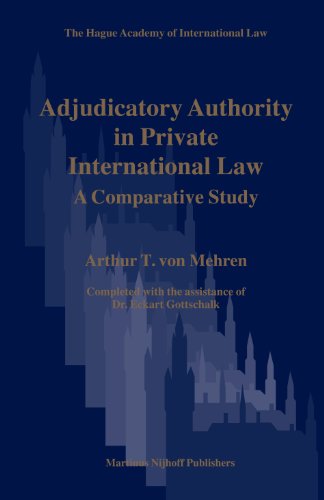
Adjudicatory Authority in Private International Law 1st Edition by Arthur Taylor Von Mehren ISBN 978-9004158818 9004158812

Original price was: $50.00.$35.00Current price is: $35.00.
Adjudicatory Authority in Private International Law 1st Edition by Arthur Taylor Von Mehren – Ebook PDF Instant Download/Delivery: 978-9004158818, 9004158812
Full download Adjudicatory Authority in Private International Law 1st Edition after payment
Product details:
ISBN 10: 9004158812
ISBN 13: 978-9004158818
Author: Arthur Taylor Von Mehren
Table of contents:
PART 1
The Foundations and Emergence of Jurisdictional Theory
Chapter I
Adjudicatory authority: Reasons for Its Existence and Its Principal Types
A. General Introduction
1. The Structural Differences of the German and American Federal Systems
2. The early history of private international law and conflict of laws
(a) Introduction
(b) The decline and fall of the Roman Empire in the West
3. General Theories Regarding Governmental Authority
(a) The principal theoretical accounts
(b) The relevance of these accounts for claims of adjudicatory authority over multistate transactions and controversies
B. Appropriate Terminology for Comparative Analysis: Basic Categories of Adjudicatory Authority
1. The Insularity of Traditional Terminologies
2. The Inadequacies of Traditional Terminologies for Comparative and Theoretical Discourses
3. Terminology and Concepts for Comparative and Theoretical Purposes: Herein of General Jurisdiction, Category-Specific Jurisdiction, and Specific Jurisdiction
C. The Appropriate Link of Jurisdiction and Choice-of-Law
1. Introductory
(a) In general
(b) Qualifications of the separateness principle
(i) Divorce
(ii) Workers’ compensation
(iii) Where serious choice-of-law difficulties, not normally encountered, arise
2. Recognition of Judgments Abroad
D. Further Considerations Affecting the Assertion of Adjudicatory Authority
1. An Inherent Right and Duty to Dispense Justice
2. A Legal Order’s Interest in Development of Certain Areas of Law
3. Economic Considerations
Chapter II
The Design of Jurisdictional Provisions
A. Basic Policies and Tensions
B. Connecting Factors: Their Design and Systemic Importance
1. The Paradigms: Administrability and Predictability; Litigational Convenience, Fairness, and Justice
2. The Tensions between the Paradigms
C. The Designers of Jurisdictional Provisions
1. In General
2. In the United States
3. In Germany
D. Designing Jurisdictional Rules and Norms
1. The United States
(a) Introductory: the influence of federalism
(b) Legislative reactions to the International Shoe decision
(i) State legislation
(ii) Treaties and federal legislation
a. In general
b. The role of international conventions and federal legislation
2. Germany
(a) Introductory
(b) The German Code of Civil Procedure (1877): Executive and legislative design
(i) The original design
(ii) The gradual increase in the importance of the courts
3- The Brussels and Lugano Conventions and the Brussels Regulation
(a) Introductory: The influence of European integration
(b) The emergence of a European legal regime for jurisdiction and the recognition and enforcement of foreign judgments
(i) The Brussels and Lugano Conventions
(ii) “Communitarization” of the conflict of laws: The Brussels Regulation
(c) The philosophy of European integration
Chapter III
The Emergence of Jurisdictional Theory in the United States and Germany
A. The United States
1. The Constitutional Bases for Judicial Control over Exercises of Adjudicatory Authority
(a) The full faith and credit clause
(b) The due process clause
(i) The background
(ii) The first steps towards constitutional control of state-court exercises of adjudicatory authority: Pennoyer v. Neff (1877)
2. The Reign of the Power Theory: 1877-1945
(a) The theory in operation
(b) Power-theory “metaphysics”
(i) The “presence” of intangibles
(ii) The “presence” of legal persons
3-The Passage from a Power to a Litigational-Justice Theory of Adjudicatory Authority
4. The Litigational-Justice Theory: International Shoe (1945) and Beyond
(a) The tension between power and litigational-justice theories
(b) Confrontation?: Shaffer v. Heitner (1977)
5. Can Claims of General and Category-Specific Jurisdiction Pass Constitutional Muster in Terms of Their Typical Effects?
6. Co-existence: Burnham v. Superior Court of California (1990)
7. Ambiguities and Uncertainties in American Jurisdictional Theory and Practice as the Twenty-First Century Begins
(a) The contemporary role and scope of power and litigational-fairness theories
(b) The respective importance of state and party concerns
(c) The complex, diverse, elusive, and changing nature of connecting factors resting on convenience, fairness, and justice
B. Germany
1. The Code of Civil Procedure (Zivilprozeßordnung) (1877)
2. The Emergence of General Theory
(a) The first efforts
(b) Pioneering works
(c) Neuhaus
3. The Contemporary Scene
(a) Heldrich
(b) Schröder
(c) Kropholler
(d) Geimer
4.
Constitutional Control and the Emergence of Comprehensive
Theory: Pfeiffer’s Contribution (1995)
(a) Pfeiffer’s system
(b) The appropriate treatment for jurisdictional purposes of plaintiffs and defendants
(c) The relevance of (minimum) contacts
(d) Application of Pfeiffer’s theory
5. The Contribution of the German Courts
(a) The principal decisions
(i) Uncoupling adjudicatory jurisdiction and venue: BGH 14 June 1965
(ii) Restricting the scope of ZPO §23: BGH 2 July 1991
(iii) Dictum of the Constitutional Court respecting ZPO $23: BVerfG 12 April 1983
(iv) Unconstitutionality of ZPO §606b, No. 1: BVerfG 3 December 1985
(b) The significance of the case law
PART 2
Basic Themes and Pervasive Issues
Chapter IV
The Actor Sequitur Forum Rei Principle: Are Defendants Jurisdictionally Preferred? Should They Be?
A. Introductory
B. The Principle’s Standing in Practice
3. Participation in the Role of Plaintiff
(a) American theory and practice
(i) The traditional position
(ii) The present standing of the rule in Adam v. Saenger
a. The Restatements Second of Conflict of Laws and of Judgments
b. Is the rule in Adam v. Saenger still constitutional?
(b) German theory and practice
(i) Introductory
(ii) The German Code of Civil Procedure (ZPO)
(c) The Brussels Convention and Regulation
D. Party Agreement Respecting the Exercise of Adjudicatory Authority: Prorogation and Derogation
1. Introductory
(a) Plan and private autonomy: in general
(b) Plan, private autonomy, and dispute resolution
2. Prorogation and Derogation
(a) Principal issues
(i) The significance of the general law of contract for forum-selection clauses
(ii) Can parties by agreement displace or modify official dispute-resolution processes?
(b) Stipulations for non-exclusive jurisdiction: prorogation clauses
(c) Stipulations for exclusive jurisdiction: derogation clauses
(i) American law
(ii) German law
a. Introductory
b. Circumstances that led to the 1974 Reform Act
C. The 1974 Reform Act
(iii) The Brussels Convention and Regulation
a. The original Convention
b. The 1978 amendments
C. The 1989 amendments
d. The Brussels Regulation
E. Party Stipulations for a Private Dispute-Resolution Process of Their
Own Design: Arbitration Agreements
1. France
2. Prussia and the German Reich
(a) Book X of the Zivilprozeßordnung (1877)
(i) In general
(ii) The arbitration law of Book X
(b) The Reform Act of 1998
3. Common-Law Jurisdictions
(a) England
Table of Con
(b) United States
(i) A general view
(ii) The “federalization” of American arbitration law
a. The original understanding
b. The erosion of the conceptual structure on which the original understanding rested: the significance of Erie R.R. v. Tompkins
C. The post-Erie change in the understanding of the FAA
d. The Southland decision (1984): concepts, history, and policy in tension
4. Supranational Arbitration Law: The New York Convention of 1958
Chapter
VI Forum Shopping and Fine-tuning: Herein of Forum Non Conveniens, Antisuit Injunctions, and Lis Pendens
A. Forum Choice by the Moving Party and the Level Playing-Field Principle
1. The Significance for Procedural Justice of Differences between Legal Systems
2. Forum Shopping
3. The Role of Public International Law and International Conventions
(a) Public international law
(b) “Decisional harmony” and forum shopping
4. The Instruments of Judicial Fine-tuning
(a) Forum non conveniens stays
(b) Antisuit injunctions
(c) Overlapping and conflicting proceedings: Lis pendens
B. Forum non conveniens: Contemporary Theory and Practice
1. Civil-Law Jurisdictions
2. Common-Law Jurisdictions
(a) The United States
(b) England
(c) Contemporary evaluations of the doctrine
C. Antisuit Injunctions
1. Civil-Law Jurisdictions
2. Common-Law Jurisdictions
(a) England and Scotland
(i) Introductory
(ii) A landmark decision: Airbus Industries G.I.E. v. Patel and Others
a. The litigation
b. The comity requirement
C. Comity in alternative forum cases
(b) The United States
(i) Recognition of sister-state injunctions
(ii) Retaliatory antisuit injunctions
D. Avoiding Duplicative Litigation: The Lis Pendens Doctrine as an Alternative to Judicial Fine-tuning
1. In General
(a) In local litigation
(b) In multistate and international litigation
2. Civil-Law Jurisdictions
3. Common-law Jurisdictions
(a) Scotland and England
(b) The United States
4. The Brussels Convention and Regulation
(a) In general
(b) The Gasser case
5-The Significance of Temporal Priority for Negative Declaratory Judgments
(a) The availability of declaratory relief
(i) When should declaratory relief be available in principle?
(ii) When is such relief available in practice?
(b) Tactical forum shopping by natural defendants in international situations
(i) French and German practices
(ii) Common-law practices
(c) Should lis pendens protection be accorded to actions for negative declaratory judgments?
(i) The positions of national legal orders
(ii) The European Union’s position
a. The applicability issue is posed: Gubisch
b. The Court of Justice treats coercive and negative declaratory actions alike: “Tatry”
C. Critique of the “Tatry” solution
6. Comparative Remarks
E. Fine-tuning in an Evolving European Union
1. In General
(a) The Union’s evolution
(b) The relationship between the two Union courts and the national courts of Union Members
2. The 1968 Convention’s raison d’être: Ensuring “a True Internal Market”
3. The Brussels Instruments’ Approach to Judicial “Fine-tuning”
4-Fine-tuning under the Forum’s Local Law in Matters that Trench on a Brussels Instrument
(a) Forum non-conveniens
(i) Introductory
(ii) The English view
a. In re Harrods
b. Owusu v. Jackson
(iii) The View of the European Court of Justice
(iv) Do the Brussels instruments forbid in all or some situations the courts of Member States granting forum non conveniens stays?
(b) Antisuit injunctions
(i) Introductory
(ii) Turner v. Grovit and Others
(iii) Are antisuit injunctions compatible with the Brussels instruments?
F. Judicial Fine-tuning: Comparative Reflections
Part 3
Epilogue
Chapter
VII Convergence and Compromise in Private International Law: The Role of International Instruments
A. Introductory
1. Legal Cultures and Their Interpenetration
2. The Twentieth Century and Globalization
B. The Task of Achieving Convergence and Harmonization
1. The Design of International Instruments: Single, Mixed, and Double Conventions
2. Regional Harmonization: The Brussels Convention
3-Worldwide Harmonization: The Proposed Hague Convention on International Jurisdiction and Foreign Judgments
(a) The project’s initial stage
(i) The United States proposal for a mixed convention
(ii) The Special Commission’s preference for a double convention
(b) Matters for which the Special Commission achieved a measure of harmonization or struck a
meaningful compromise
(i) Forum non-conveniens
(ii) Lis pendens
(iii) Damage awards
C. The Teachings of the Hague Experience
1. The Changing Scene
2. Efforts to Achieve Convergence and to Strike Compromises: The First Stage (June 2001) of the Nineteenth Diplomatic Session
(a) A scaled-down or a comprehensive convention?
(b) The difficulty of agreein prohibited
(c) A Step Back: The Hague Convention on Choice of Court Agreements
(i) One ground of jurisdiction
(ii) Unregulated bases of jurisdiction and excluded matters
(iii) Forum non conveniens and lis pendens
(iv) Recognition and enforcement
3. Universal Conventions in Matters of Private International Law: Twenty-first Century Prospects
D. The Future
People also search for:
adjudicatory jurisdiction
adjudicatory hearings are initiated by
adjudicatory body
private adjudicator
private authority meaning
Tags: Arthur Taylor Von Mehren, Adjudicatory Authority, Private International Law