

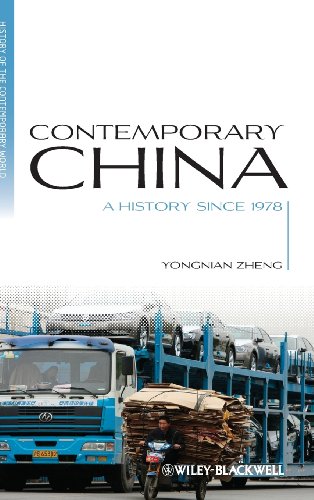
Contemporary China A History since 1978 1st Edition by Yongnian Zheng ISBN 0470655801 978-0470655801

Original price was: $50.00.$35.00Current price is: $35.00.
Contemporary China A History since 1978 1st Edition by Yongnian Zheng – Ebook PDF Instant Download/Delivery: 0470655801 , 978-0470655801
Full download Contemporary China A History since 1978 1st edition after payment
Product details:
ISBN 10: 0470655801
ISBN 13: 978-0470655801
Author: Yongnian Zheng
Using new research and considering a multidisciplinary set of factors, Contemporary China offers a comprehensive exploration of the making of contemporary China.
- Provides a unique perspective on China, incorporating newly published materials from within and outside China, in English and Chinese. Discusses both the societal and economic aspects of China’s development, and how these factors have affected Chinese elite politics
- Includes coverage of recent political scandals such as the dismissal of Bo Xilai and the intrigue surrounding the 18th National Congress elections in late 2012
- Discusses the reasons for―and ramifications of―the gap that exists between western perceptions of China and China itself
Contemporary China A History since 1978 1st Table of contents:
Chapter 1: The Maoist Legacy
Political System
The nomenklatura system
Central leading small groups (CLSGs)
Xitong
Dangzu
The party and the military
State–Society Relations
Economic System
Elite Politics
Maoism: Experiment and Failure
Notes
References
Chapter 2: Elite Politics
Elite Politics after Mao
Factional politics
The Third Plenum
Deng Xiaoping Era, 1978–89
Power politics
Ideological change
Elite recruitment
Political exit for senior leaders
Grooming younger leaders
Jiang Zemin Era, 1989–2002
From conservative to reformist: 1989–92
Power consolidation
Ideological change
Elite recruitment
Political exit
Grooming younger leaders
Hu Jintao Era, 2002–12
Elite politics
Removing the disloyal
Institutionalizing power succession
Ideology change and policy shift
Conclusion
Notes
References
Chapter 3: Economic Reform
Reform under Deng Xiaoping (1978–92)
The rural reforms: Household responsibility systems and township and village enterprises
The state-owned enterprise reforms in the 1980s
Fiscal and financial reforms
Price reforms, inflation, and the 1989 interludes
Southern tour
Economic Reform under Zhu Rongji (1993–2002)
En route to the reform year
The reform year of 1994
SOE reforms in the 1990s: “Let go of the small”
The SOE reform: “Grip the large”
Rural declines and the rise of migrant workers
Economic Reform under Wen Jiabao (2003–2013)
Economic reform entering deep waters
Economic reforms continued
SOEs, local governments, and financial deepening
New vision, new limitations
Structural Change in the Reform Era
Macroeconomic trend and structural changes
Structural changes in growth dynamics and national income distribution
Chinese Economic Reform at the Crossroads
Notes
References
Chapter 4: Globalization
Foreign Trade
Trade integration
The Evolution of China’s Trade Polices
Centrally planned system before 1978
Decentralization, 1978–92
Harmonization with international standards, 1993–2001
Membership in the WTO, 2002–
Impacts of Foreign Trade
Foreign Investment
Pattern of Foreign Investment
Capital inflows
Capital outflows
The Evolution of Foreign Investment Policies
Special economic zones, 1979–92
Transition period, 1993–2001
Going global, 2002–
Impacts of Foreign Investment
Notes
References
Chapter 5: Civil Society
Market Economy and Political Interests
The Expansion of the Private Sector and Private Space
The Rise of the Middle Class
Non-Governmental Organizations (NGOs)
Social Media and Netizens
Conclusion
Notes
References
Chapter 6: Social Discontent
Income Disparities and Social Grievance
Urban–rural disparities
Inequality in urban areas
Regional disparity
Political Distrust
Rural Protests
Labor Protests
Middle-Class Protests
Ethnic Conflicts
Conclusion
Notes
References
Chapter 7: Cultural Changes
The Rise of Liberalism in the 1980s
Fascination with Western cultures
The university forum craze
A dream for democracy
Obsession with Western media
Ideas matter
Nationalism Since the 1990s
Internet savvy youths
Transnational Fen Qing
The Internetization of protests
The New Left
The Cultural Renaissance Movement
Conclusion
Notes
References
Chapter 8: De Facto Federalism
Economic Reform and De Facto Federalism
Intergovernmental Decentralization
Intergovernmental economic decentralization
Intergovernmental political decentralization
The centralized political structure
Decentralization and Its Consequences
Selective Recentralization
Taxation reform
Central banking system reform
Political recentralization
State Incapacity
De facto Federalism and China’s Foreign Policy
Conclusion
Notes
References
Chapter 9: Social Policy Reform
Social Policy under Jiang
Social Policy Reform under Hu
Dynamics of Social Policy Reform
Social insurance
Social protection
Welfare provision
Education
Health Care
Housing
Conclusion
Notes
References
Chapter 10: Bureaucracy and Governance
Dynamics of Restructuring the Bureaucratic State
The 1982 Restructuring by Zhao Ziyang
The 1988 and 1993 Restructurings by Li Peng
The 1998 Institutional Reform under Zhu Rongji
The 2003 and 2008 Reforms by Wen Jiabao
Conclusion
Notes
References
Chapter 11: Democratization
Socioeconomic Transformation and Political Changes
Hegemonization: Domination and Legitimation
Rationalizing Party–State Relations
The three-in-one system
Party secretary as the head of people’s congress
More space and greater autonomy for professionalism
Hegemonization and Social Participation
Developing different forms of local democracy
Expanding the social base
People also search for Contemporary China A History since 1978 1st:
china timeline history
china contemporary history
china history 1980s
a contemporary course in chinese
chinese contemporary history