

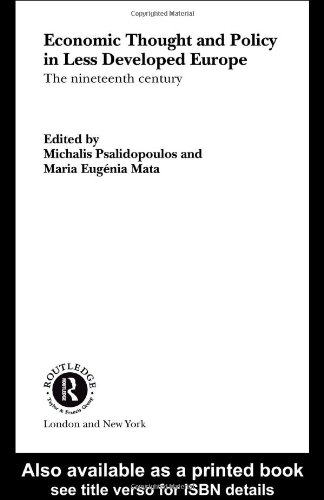
Economic Thought Policy in Less Developed Europe 1st Edition by Maria Eugenia Mata, Michalis Psalidopoulos ISBN B0D1N64HWN 978-1134514953

Original price was: $50.00.$35.00Current price is: $35.00.
Economic Thought Policy in Less Developed Europe 1st Edition by Maria Eugenia Mata, Michalis Psalidopoulos – Ebook PDF Instant Download/Delivery: B0D1N64HWN , 978-1134514953
Full download Economic Thought Policy in Less Developed Europe 1st edition after payment
Product details:
ISBN 10: B0D1N64HWN
ISBN 13: 978-1134514953
Author: Maria Eugenia Mata, Michalis Psalidopoulos
The essays in this volume explore and discuss the process of dissemination of economic ideas among Europe’s less developed countries and regions, as well as the interaction between economic thought and economic policy in different times and places during the nineteenth century.
The comparative approach adopted sheds new light on the course of economic development in Europe’s less developed countries in the nineteenth century and the role played by political economy. Amongst a host of others, the topics covered include:
- economic policy in Denmark
- monetary and trade policy in Norway
- the influence of the German Historical School in Finland
- land Reform and the abolition of serfdom in Russia and in Poland
With contributions that disclose important insights into national traditions in economic thought and policy, and the diffusion of ideas in Europe, this work will be essential reading for all scholars of the history of economic thought.
Economic Thought Policy in Less Developed Europe 1st Table of contents:
1 Economic thought and policy in nineteenth-century less developed Europe: Issues and aspects of their interaction
Introduction
A typology of countries
Political issues
Economic policy issues
Economic development, seen ex post
The development and diffusion of economics
The essays
Concluding remarks
Notes
References
2 Economic theory and economic development in Denmark, 1848–1914
Introduction
Political developments, 1848–1914
The Danish economy, 1848–1914
Danish economics, 1848–1914
Conclusion
Notes
References
3 The emergence of an independent Norwegian economic policy: Some notes on current views and empirical findings
Introduction
Monetary policy
The duality of tariffs: public finances and foreign trade policy
Norwegian economic policy and economic growth
Final remarks
Notes
References
4 The influence of the German Historical School in Finnish economic thought around the turn of the century
Introduction
Ideological and social background of the professionalization of Finnish economic science
Reception of German historical economics in Finland
Discussion on ‘Workers’ Question’ and the controversy concerning liberalism
The ‘Methodenstreit’ from the Finnish perspective
Historical economics as empirical social research
Conclusions
Notes
References
5 B.N. Chicherin: Some liberal aspects of the emancipation of the serfs in Russia
Introduction
B.N. Chicherin: life and activities
Chicherin and the emancipation of the serfs
The reform
Conclusions
Notes
References
6 Liberal ideas and Slavonic Community: Tomasz Potocki’s programme for Poland
Introduction
Liberal ideas
Economics of agriculture
European agriculture
The case of Poland
Conclusion
Notes
References
7 Resisting liberalism: Theorizing backwardness and development in Rumania before 1914
I
II
III
IV
V
VI
VII
Notes
References
8 Ottoman economic thought and economic policy in transition: Rethinking the nineteenth century
Why was there no physiocracy in the Ottoman Empire?
The Classical approach makes its debut
Re-inventing the alternative: historical school alla turca
The threshold of originality: a foray into the dependency approach
Notes
References
9 Aspects of economic thought and policy in Serbia, 1850–1900
Historical background
Kosta Cukic
Mijatovic
Vujic
Concluding remarks
Notes
References
10 Economic thought and monetary policy in nineteenth-century Greece
Introduction
Origins of the Greek banking system
The issuing policy of the National Bank of Greece
The bank as lender of last resort
The state interference in monetary policy
The establishment of inconvertibility
Conclusion
Notes
References
11 Political economy in Italy: Competition and civil society in the Milanese school, 1750–1850
Introduction
Pietro Verri: commercial society, civil society and governing the economy
Verri’s contribution to the economic theory of civil society
Italian economic thought in the early nineteenth century: the morality of industry
Incivilimento and progress
Leading lines in early nineteenth-century Italian economic thought
Concluding remarks
Notes
References
12 How are we to become like them?: Political economy as a political agenda in early nineteenth-century Portugal
Introduction1
The importance of political economy for the amendment of the ancien régime
The critique of the mercantile system and the claims for economic freedom
Economic policy and the path towards wealth
The option by gradualism
The gradualist swansong
Change without restrictions: political economy within political liberalism
On building up a new agenda
The making of a new elite: the academic institutionalization of political economy
On taming political economy
Notes
References
13 Friedrich List and Oliveira Marreca: Some odd coincidences
Two disorderly careers
Theoretical and methodological positions
Economic policy proposals
The nation and the Zollverein
Concluding remarks
Notes
References
14 The western periphery: Irish agriculture and Irish political economy in the nineteenth century
Introduction
The persistence of feudalism in Ireland
Pre-Famine political economy in Ireland
The Famine and its aftermath
Political economy after the Famine
People also search for Economic Thought Policy in Less Developed Europe 1st :
economic policy with europe
economic policy thoughts for today and tomorrow
economic policy thoughts for today and tomorrow pdf
the economic policy with europe changed when
an economic policy is quizlet
Tags: Maria Eugenia Mata, Michalis Psalidopoulos, Economic Thought, Less Developed