

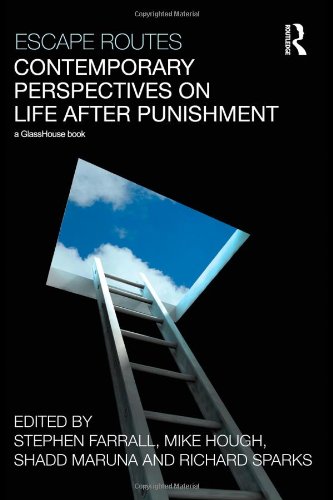
Escape Routes Contemporary Perspectives on Life after Punishment 1st Edition by Stephen Farrall, Richard Sparks, Shadd Maruna, Mike Hough ISBN 0415628679 978-0415628679


Original price was: $50.00.$35.00Current price is: $35.00.
Escape Routes Contemporary Perspectives on Life after Punishment 1st Edition by Stephen Farrall, Richard Sparks, Shadd Maruna, Mike Hough – Ebook PDF Instant Download/Delivery: 0415628679 , 978-0415628679
Full download Escape Routes Contemporary Perspectives on Life after Punishment 1st edition after payment
Product details:
ISBN 10: 0415628679
ISBN 13: 978-0415628679
Author: Stephen Farrall, Richard Sparks, Shadd Maruna, Mike Hough
Escape Routes: Contemporary Perspectives on Life After Punishment addresses the reasons why people stop offending, and the processes by which they are rehabilitated or resettled back into the community. Engaging with, and building upon, renewed criminological interest in this area, Escape Routes nevertheless broadens and enlivens the current debate. First, its scope goes beyond a narrowly-defined notion of crime and includes, for example, essays on religious redemption, the lives of ex-war criminals, and the relationship between ethnicity and desistance from crime. Second, contributors to this volume draw upon a number of areas of contemporary research, including urban studies, philosophy, history, religious studies, and ethics, as well as criminology. Examining new theoretical work in the study of desistance and exploring the experiences of a number of groups whose experiences of life after punishment do not usually attract much attention, Escape Routes provides new insights about the processes associated with reform, resettlement and forgiveness. Intended to drive our understanding of life after punishment forward, its rich array of theoretical and substantive papers will be of considerable interest to criminologists, lawyers, and sociologists.
Escape Routes Contemporary Perspectives on Life after Punishment 1st Table of contents:
Chapter 1 Applying redemption through film
Introduction
The specificity of redemption
Redemption as a more malleable concept
Redemption in film
Towards a criminologically and theologically fertile model of redemption
References
Chapter 2 Steps towards desistance among male young adult recidivists
The age-crime curve and its explanation
The Sheffield desistance study
Characteristics of the sample
Offending subsequent to initial interview: Did respondents desist?
Official offending
Self-reported offending
Views about future offending
Predicting later offending
A case study
An interactive model of the early stages of desistance
Notes
References
Appendix
Views about future offending (Table 2.3)
Interview 1
Interview 2
Interview 3
Interview 4
Self-reported offending (Table 2.5)
Official offending (Table 2.6)
Chapter 3 Youth justice?
Introduction1
Flaws in scientific foundations of policy
System contact and deviancy amplification
Aim of the chapter
Structure of the chapter
Scottish youth justice in comparative context
History and philosophy
Key institutions and procedures
Recent changes
The Edinburgh study of youth transitions and crime
Form of analysis
Phase 1: selection effects
Police beat officer decisions to charge
Police juvenile liaison officer decisions to refer cases to the reporter
Reporter decisions to refer a case to a hearing
Phase 2: The impact of agency contact on subsequent behaviour
Results of analysis
Nature of social work contact and services offered
Discussion and implications
Filtering and labelling
Damaging consequences of agency contact
Why intervention may be failing
Is doing nothing better than doing something?
Conclusion
Notes
References
Chapter 4 Feminist research, state power and executed women
Introduction: condemned women, pardons and life after punishment
Feminist epistemology and the production of knowledge
The construction of official discourse: the state’s story
The retrieval of subjugated knowledge: Louie’s story
Re-constructing subjugated knowledge – the creation of an ‘alternative truth’
Theoretical implications
Conclusion
Acknowledgements
Notes
References
Chapter 5 Paths of exclusion, inclusion and desistance
Introduction
The Teesside studies of youth transitions and social exclusion
Analysing youth transitions
Key, general findings
The onset and establishment of criminal careers: Teesside findings in brief
Street corner society and leisure time crime
The entwining of criminal careers with dependent drug careers
Understanding desistance
Parenthood, partnerships and employment
Separation from peer groups
Purposeful activity
The significance of ‘critical moments’
The Teesside studies and contemporary criminology: some theoretical reflections
Historical and biographical context
Career, contingency and generation
Conclusion
Notes
References
Chapter 6 The reintegration of sexual offenders
Resettlement and desistance from crime
‘The risk-based model’
‘The new penology’: risk, governance and precautionary logic
The legislative and policy framework
Popular discourses on sex offender reintegration
The risks of the ‘risk-based’ model
Knowledge-risk-security
Disintegrative shaming
The ‘strengths-based’ model
The strengths of the ‘strengths-based’ model
Circles of support and accountability
Addressing the problems with reintegration
Circles and the ‘strengths-based’ approach
The importance of ‘place’
The role of hope
Reintegrative shaming
Conclusion
Notes
References
Chapter 7 All in the family
Introduction
An overview of the UK Bangladeshi population
Methodology
Re-connecting with families
Re-constructing a future together: re-building trust and shared emotions
Marriage and desistance for Bangladeshis
Family support: practical assistance and structuring time
Islam and desistance: forgiving the past, supporting the future
Shared aspirations: ‘buying back a future’
Conclusion
Note
References
Primary sources
Chapter 8 Inside-out: transitions from prison to everyday life
The reconstruction of biographical processes — a conflict theoretical approach
“Inside I’m a different person than outside”: incarceration as an ambivalent promise of change
Biography, autonomy and coping with imprisonment
Autonomy-in-relation
Rationalisation of conflict
Struggling for autonomy
Imprisonment as an inner biographical turning point
Processing imprisonment as a biographical struggle for autonomy
Conclusion
Notes
References
Chapter 9 ‘I can’t make my own future’
Introduction
Existentialism and the future
Existentialism – thinking about the future
Existentialism and sociology
Existentialism and criminology
Methods
Welcoming change; being and feeling ‘in control’
Unwelcome change; self as constituted by the future
Discussion
Notes
References
Chapter 10 Life after punishment for Nazi war criminals
Life after punishment, reputation and transitional justice
The ‘prisoners’ dilemma’3 of transitional justice
Reputations in a changing normative climate: legal procedures, moral assessment and public opinion in post-war German society
Case studies of former Nazi war criminals and their lives after punishment
The Nazi elite
The Nazi military and bureaucratic elite
The military elite
The bureaucratic elite: diplomats, SS leaders and lawyers
Professionals: doctors
Members and commanders of SS task forces
Concentration camp guards
Reputations, the transitional moment and the longue durée of normative change
People also search for Escape Routes Contemporary Perspectives on Life after Punishment 1st :
escape route concert band
escape routes contemporary perspectives on life after punishment
escape routes lodging
escape route book
escape room context clues
Tags: Stephen Farrall, Richard Sparks, Shadd Maruna, Mike Hough, Escape Routes, Contemporary Perspectives