

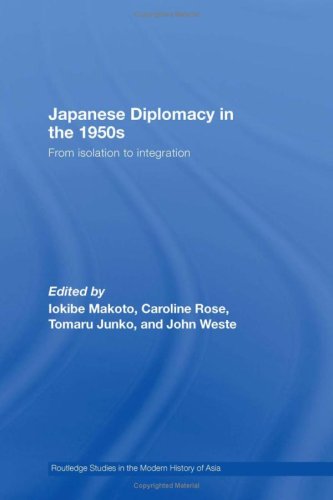
Japanese Diplomacy in the 1950s 1st Edition by John Swenson Wright, Makoto Iokibe ISBN 0415372968 978-0415372961


Original price was: $50.00.$35.00Current price is: $35.00.
Japanese Diplomacy in the 1950s 1st Edition by John Swenson Wright, Makoto Iokibe – Ebook PDF Instant Download/Delivery: 0415372968, 978-0415372961
Full download Japanese Diplomacy in the 1950s 1st edition after payment
Product details:
ISBN 10: 0415372968
ISBN 13: 978-0415372961
Author: John Swenson Wright, Makoto Iokibe
This book provides a detailed examination of Japan’s diplomatic relations in the 1950s, an important decade in international affairs when new structures and systems emerged, and when Japan established patterns in its international relationships which continue today. It examines the process of Japan’s attempts to rehabilitate itself and reintegrate into a changing world, and the degree of success to which Japan achieved its goals in the political, economic and security spheres. The book is divided into three parts, each containing three chapters: Part I looks at Japan in the eyes of the Anglo-American powers; Part II at Japanese efforts to gain membership of newly forming regional and international organizations; and Part III considers the role of domestic factors in Japanese foreign policy making. Important issues are considered including Japanese rearmament and the struggle to gain entry into the United Nations. In contrast to much of the academic literature on post-war Japanese diplomacy, generally presenting Japan as a passive actor of little relevance or importance, this book shows that Japan did not simply sit passively by, but formed and attempted to instigate its own visions into the evolving regional and global structures. It also shows that whilst Japan did not always figure as highly as its politicians and policy makers may have liked in the foreign policy considerations of other nation states, many countries and organizations did attach a great deal of importance to re-building relations with Japan throughout this period of re-adjustment and transformation.
Japanese Diplomacy in the 1950s 1st Table of contents:
PART I Japan, Anglo-American rivalry, and indifference
1 The US, Britain, Japan, and the issue of casus belli 1951–2: Could a Soviet attack on Japan justify starting a third world war?
No stop line in Japan: COS (51) 106 and the British approach to a Soviet attack on Japan
The US military concern: a Soviet attack on Japan and its global meaning
The Japanese government’s views on rearmament and the Soviet threat to Japan
Anglo-American negotiations on casus belli
Japanese rearmament and Ridgway’s fear of a Soviet attack on Japan
Behind the San Francisco peace conference: Anglo-American talks on a Soviet attack on Japan and casus belli
The British acceptance of the stop line, Japan
Conclusion
2 Great Britain and Japanese rearmament
Introduction
Demilitarizing Japan
Rearming Japan
Remote control: HMG on Japanese rearmament
‘We do not know how clear US thinking is on this question’: Anglo-American relations and Japanese rearmament
Aftermath: ‘we have no need to fear’
Conclusion
3 Japan in British Regional Policy towards South-East Asia
British regional policies and Japan: 1945 to 1954
The revision of regional policies and Japan’s position: 1955 onwards
British new look policies: the Japanese context
British distrust of the ‘valuable new friend’
Conclusion
PART II Japan’s re-emergence in regional and international organizations
4 Japan at the Bandung Conference: An attempt to assert an independent foreign policy
US concerns about Bandung and ‘a shift toward neutralism in Japan’
Consultations between allies
America’s anxieties about the Japanese delegation
The semblance of a compromise
America’s response to the Japanese performance at the conference
Conclusion
5 Japan’s entry into ECAFE
Introduction
ECAFE: The emergence of Asian regionalism
Occupied Japan and ECAFE: informal and indirect participation
Gaining associate membership
Towards full membership
Conclusion
6 Japan’s struggle for UN membership in 1955
Introduction
Developments prior to the tenth session of the General Assembly
Reactions to the Canadian proposal
The US, Taipei and the Outer Mongolia question
The State Department’s change in policy and Taipei’s isolation
The vote on admission and aftermath
Conclusion
PART III Japanese and US domestic constraints on foreign policy
7 The Lucky Dragon Incident of 1954: A failure of crisis management?
The outline of the crisis
Testing and nuclear strategy
Criticisms and misperceptions
Rastvorov’s revelations
Scientific shortcomings
Resolving the crisis
8 The revision of the US-Japan security treaty and Okinawa: Factional and domestic political constraints on Japanese diplomacy in the 1950s
Introduction
The draft treaty area and the question of Okinawa
Political problems with the Treaty area
Reaching agreement
Agreed minute on Okinawa’s status
Conclusion
9 Breaking the deadlock: Japan’s informal diplomacy with the People’s Republic of China, 1958–9
May 1958: the Sino- Japanese rift and Japan’s initial responses
The movement to break the deadlock in Sino-Japanese relations
Conclusion
10 Conclusion
People also search for Japanese Diplomacy in the 1950s 1st :
japanese diplomacy in the 1950s from isolation to integration
japanese companies during ww2
japanese holdouts after ww2
are japanese ashamed of ww2
japanese diplomatic history
Tags: John Swenson Wright, Makoto Iokibe, Japanese Diplomacy, the 1950s