

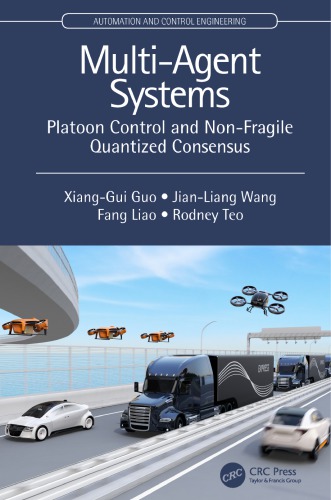
Multi Agent Systems Platoon Control and Non Fragile Quantized Consensus 1st Edition by Xiang Gui Guo, Jian Liang Wang, Fang Liao, Rodney Swee Huat Teo ISBN 0367254328 978-0367254322


Original price was: $50.00.$35.00Current price is: $35.00.
Multi Agent Systems Platoon Control and Non Fragile Quantized Consensus 1st Edition by Xiang Gui Guo, Jian Liang Wang, Fang Liao, Rodney Swee Huat Teo – Ebook PDF Instant Download/Delivery: 0367254328, 978-0367254322
Full download Multi Agent Systems Platoon Control and Non Fragile Quantized Consensus 1st edition after payment
Product details:
ISBN 10: 0367254328
ISBN 13: 978-0367254322
Author: Xiang Gui Guo, Jian Liang Wang, Fang Liao, Rodney Swee Huat Teo
Multi-Agent Systems: Platoon Control and Non-Fragile Quantized Consensus aims to present recent research results in designing platoon control and non-fragile quantized consensus for multi-agent systems. The main feature of this book is that distributed adaptive sliding mode control (SMC) algorithms are proposed to guarantee strong string stability based on modified constant time headway (MCTH) policy. The MCTH policy is used to remove the unrealistic assumption in the most existing literature that initial spacing, velocity and acceleration errors are zero. This monograph investigates the platoon control issue by combining SMC technique with neural network and fuzzy logic system approximation methods.
Multi Agent Systems Platoon Control and Non Fragile Quantized Consensus 1st Table of contents:
1. Introduction
1.1 Platoon Control Problem
1.1.1 Spacing Policies
1.1.2 Actuator Nonlinearities
1.1.3 Communications/Sensing Restricted Applications
1.2 Non-Fragile Quantized Consensus
1.2.1 Quantized Consensus
1.2.2 Non-Fragile Control Problems
1.3 Preview of Chapters
2. Preliminaries
2.1 Notations
2.2 Acronyms
2.3 String Stability Theory
2.4 Basic Algebraic Graph Theory
2.5 H∞ Performance Index
2.6 Some Other Definitions and Lemmas
3. String Stability of Vehicle Platoons with External Disturbances
3.1 Introduction
3.2 Model Description and Problem Formulation
3.2.1 Vehicle Dynamics
3.2.2 Control Objective
3.3 Design of Distributed Adaptive Integral Sliding Mode Control
3.3.1 Zero Initial Spacing Error Case
3.3.2 Non-zero Initial Spacing Error Case
3.4 Numerical Examples
3.5 Conclusion
4. String Stability of Vehicle Platoons with Nonlinear Acceleration Uncertainties
4.1 Introduction
4.2 Vehicle Platoon and Problem Formulation
4.2.1 Vehicle Platoon
4.2.2 Problem Formulation
4.3 Distributed Adaptive Integral Sliding Mode Control Strategy
4.3.1 Control Strategy 1: TCTH Control Law
4.3.2 Control Strategy 2: MCTH Control Law
4.4 Simulation Study and Performance Results
4.4.1 Example 1 (Numerical Example)
4.4.2 Example 2 (Practical Example)
4.5 Conclusion
5. CNN-Based Adaptive Control for Vehicle Platoon with Input Saturation
5.1 Introduction
5.2 Vehicle-Following Platoon Model and Preliminaries
5.2.1 Vehicle-Following Platoon Description
5.2.2 Chebyshev Neural Network
5.3 Distributed Adaptive NN Control Design and Stability Analysis
5.3.1 Control Scheme I: TCTH Policy
5.3.2 Control Strategy II: MCTH Control Law
5.4 Simulation Study and Performance Results
5.4.1 Example 1 (Numerical Example)
5.4.2 Example 2 (Practical Example)
5.5 Conclusion
6. Adaptive Fuzzy Fault-Tolerant Control for Multiple High Speed Trains
6.1 Introduction
6.2 High Speed Train Dynamics and Preliminaries
6.2.1 Model Description of High Speed Train Dynamics
6.2.2 Fuzzy Logic Systems
6.2.3 Problem Formulation
6.3 PI-Based Sliding Mode and Coupled Sliding Mode
6.4 Adaptive Fuzzy Control Design and Stability Analysis
6.4.1 Controller Design for Fault-Free Case
6.4.2 Fault-Tolerant Controller Design with Actuator Faults
6.5 Simulation Study and Performance Results
6.5.1 Simulation Results of Theorem 6.1
6.5.2 Simulation Results of Theorem 6.2
6.6 Conclusion
7. Collision Avoidance for Vehicle Platoon with Input Deadzone
7.1 Introduction
7.2 Vehicular Platoon Model and Preliminaries
7.2.1 Vehicular Platoon Description
7.2.2 Radial Basis Function Neural Network
7.2.3 Problem Formulation
7.3 Distributed Adaptive NN Control Design
7.4 Simulation Study
7.5 Conclusion
8. Neuro-Adaptive Quantized PID-Based SMC of Vehicular Platoon with Deadzone
8.1 Introduction
8.2 Vehicle-Following Platoon Model and Preliminaries
8.2.1 Vehicle-Following Platoon Description
8.2.2 Nonlinear Actuator Decomposition
8.2.3 Radial Basis Function Neural Network
8.3 Neuro-Adaptive Quantized PIDSMC Design and Strong String Stability Analysis
8.3.1 MCTH Policy and Control Problem
8.3.2 PID-Based Sliding Mode Control Design
8.3.3 Stability Analysis
8.4 Simulation Study
8.5 Conclusion
9. Low-Complexity Control of Vehicular Platoon with Asymmetric Saturation
9.1 Introduction
9.2 Vehicular Platoon Description
9.3 Adaptive PIDSMC Design and Strong String Stability Analysis
9.3.1 Control Problem
9.3.2 PID-Based Sliding Mode Control Design
9.4 Simulation Results
9.5 Conclusion
10. Non-Fragile Quantized Consensus for Multi-Agent Systems Based on Incidence Matrix
10.1 Introduction
10.2 Uniform Quantizer and Logarithmic Quantizer
10.3 Problem Formulation
10.4 Non-Fragile Quantized Controller Design
10.4.1 Non-Fragile Control with Uniform Quantization
10.4.2 Non-Fragile Control with Logarithmic Quantization
10.5 Numerical Example
10.6 Conclusion
11. Non-Fragile H∞ Consensus for Multi-Agent Systems with Interval-Bounded Variations
11.1 Introduction
11.2 Problem Formulation
11.3 Non-Fragile H∞ Consensus for Multi-Agent Systems
11.4 Numerical Example
11.5 Conclusion
12. Quantized H∞ Consensus for Multi-Agent Systems with Quantization Mismatch
12.1 Introduction
12.2 Quantized H∞ Consensus for General Linear Dynamics
12.3 Quantized H∞ Consensus for Lipschitz Nonlinearity
12.4 Numerical Examples
12.4.1 Example 1
12.4.2 Example 2
12.5 Conclusion
People also search for Multi Agent Systems Platoon Control and Non Fragile Quantized Consensus 1st :
multi agent systems platoon control and non fragile quantized consensus
multi agent system control
what is multi agent system
multi-agent control
multi-agent system
Tags: Xiang Gui Guo, Jian Liang Wang, Fang Liao, Rodney Swee Huat Teo, Multi Agent, Quantized Consensus