

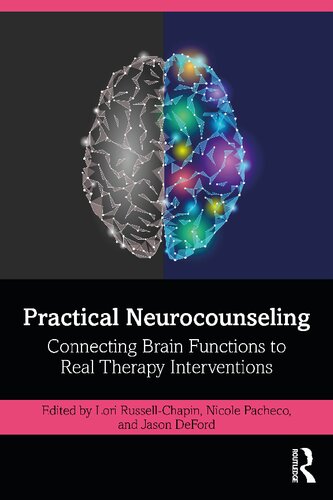
Practical Neurocounseling Connecting Brain Functions to Real Therapy Interventions 1st Edition by Lori Russell Chapin, Nicole Pacheco, Jason DeFord ISBN 036741743X 978-0367417437


Original price was: $50.00.$35.00Current price is: $35.00.
Practical Neurocounseling Connecting Brain Functions to Real Therapy Interventions 1st Edition by Lori Russell Chapin, Nicole Pacheco, Jason DeFord – Ebook PDF Instant Download/Delivery: 036741743X , 978-0367417437
Full download Practical Neurocounseling Connecting Brain Functions to Real Therapy Interventions 1st edition after payment
Product details:
ISBN 10: 036741743X
ISBN 13: 978-0367417437
Author: Lori Russell Chapin, Nicole Pacheco, Jason DeFord
Practical Neurocounseling demonstrates the importance of considering brain health in counseling, showing mental health professionals how to understand and assess the functioning of different parts of the brain without sophisticated software or intensive training.
Chapters map out individual brain areas and give tips and guidance that therapists can use to tailor their approaches to meet specific cognitive, emotional, and behavioral needs. The interventions provided in each chapter are gender and culturally neutral, with easy-to-follow directions for application. LORETA brain maps for each of the 19 brain sites help identify brain locations to brain function and areas of dysregulation, and corresponding step-by-step interventions can be used to regulate sites and behaviors.
More than just a collection of techniques, Practical Neurocounseling is a valuable guide for clinicians interested in the relationship between brain activity and behavior. It’s also an ideal book for professors and students in any neurocounseling course and for clinicians working in talk therapy.
Practical Neurocounseling Connecting Brain Functions to Real Therapy Interventions 1st Table of contents:
PART I Neurocounseling Theory and Knowledge
1 Understanding the World of Neurocounseling and Chapter Summaries
Chapter 2: The Case of Patrice: Struggling for Stability and Independence
Chapter 3: Assessment, Treatment Planning, and Outcome Evaluation
Chapter 4: Prefrontal Cortex (FP1 and FP2): Leading with the CEO of the Brain
Left Prefrontal Cortex (FP1)
Right Prefrontal Cortex (FP2)
Chapter 5: Frontal Lobes: Seeing the Trees and Seeing the Forest for the Trees
F3
Right Frontal Lobe (F4)
Midline Frontal Lobe (FZ)
Left Frontal Lobe (F7)
Right Frontal Lobe (F8)
Chapter 6: Sensory Motor (C3, CZ, and C4): Making the World Move
Left Central (C3)
Right Central (C4)
Chapter 7: Temporal Lobes (T3, T4, T5, and T6): The Integration of the World, Myself, and Others
Left Temporal (T3)
Right Temporal (T4)
Left Temporal (T5)
Right Temporal (T6)
Chapter 8: Parietal Lobes (P3, PZ, and P4) – Making Sense of One’s Experience and the World Around Me
Central Parietal (PZ)
Left Parietal (P3)
Right Parietal (P4)
Chapter 9: Occipital Lobes (O1 and O2): Visualizing the World through Recognition and Patterns
Left Occipital (O1)
Right Occipital (O2)
Chapter 10: Conclusions: Coming Full Circle
Conclusions
References
2 Demonstrating Neurocounseling and Neuroanatomy with the Case of Patrice: Struggling with Stability and Independence
The Case of Patrice: Struggling for Stability and Independence
Neuroanatomy and Brainwaves
Brain Quiz Answers
A More Comprehensive Look at the Brain
Brain Structures and Functions
Forebrain
Hindbrain
Midbrain
Cerebral Cortex
Cingulate Gyrus
Right Hemisphere
Left Hemisphere
Brain Lobes
Neurobiology
Brainwave Bandwidths
Brain Electrical Activity
Neurons
Conclusions
References
3 Integrating Neurocounseling with Assessments, Treatment Planning, and Outcome Evaluation
Psychosocial Medical History
Neurological Dysregulation Risk Assessment
Screening Checklists
Anxiety
Depression
Trauma
Attention
Problem Checklist
Other Potentially Relevant Measures
Insomnia
Body Perception
Anger
Executive Function
Cognitive Functioning
Baseline Measures of Physiological and Neurological Functioning
Test of Continuous Performance
Cognitive Assessment
Peripheral Skin Temperature
Heart Rate Variability
Quantitative Electroencephalography
Treatment Planning
Prioritizing Presenting Problems
Head Map of Functions
Selecting Neurocounseling Interventions
Coaching on Behavioral Changes to Increase Neuroplasticity
Neurocounseling Outcome Evaluation
Objective Assessment of Change
Client Self-Report of Change
Observational Information
Conclusions
References
PART II Neurocounseling Applications
4 Prefrontal Cortex (FP1 and FP2): Leading with the CEO of the Brain
FP1
Implications of Dysregulation
Two Neurocounseling Interventions
Reframing
Task Breakdown/Planner
FP2 Location and Function
Implications of Dysregulation
Two Neurocounseling Interventions
Diaphragmatic Breathing
Kirtan Kriya meditation
Conclusions
References
5 Frontal Lobes (F3, FZ, F4, F7, and F8): Seeing the Trees and Seeing the Forest for the Trees
F3 Location and Function
Implications of Dysregulation
Two Neurocounseling Interventions
Gratitude Journaling
ANT Therapy
F4 Location and Function
Implications of Dysregulation
Two Neurocounseling Interventions
Visualization
Analogy Completion
FZ Location and Function
Implications of Dysregulation
Two Neurological Interventions
Mindful Meditation
Heart Rate Variability
F7 Location and Function
Implications of Dysregulation
Two Neurocounseling Interventions
Phonological Components Analysis
Response Elaboration Training
F8 Location and Function
Implications of Dysregulation
Two Neurocounseling Interventions
Sleep Hygiene/Lavender Relaxation
Mindfully Eating
Conclusions
References
6 Sensory Motor (C3, CZ, and C4): Helping the World Move
C3 Location and Function
Implications of Dysregulation
Two Neurocounseling Interventions
Mindfulness Jar
Diaphragmatic Breathing
CZ Location and Function
Implications of Dysregulation
Two Neurocounseling Interventions
Dancing
Puzzle
C4 Location and Function
Implications of Dysregulation
Two Neurocounseling Interventions
Progressive Muscle Relaxation
Mindfulness Meditation (Figure 6.6)
Conclusions
References
7 Temporal Lobes (T3, T4, T5, and T6): Integrating the World, Myself, and Others
T3 Location and Function
Implications of Dysregulation
Two Neurocounseling Interventions
Mnemonic Devices
Acrostics
Acronyms
Rhyme and Song
Visual Memory Triggers
Directions
Closed Eye Art
Directions
T4 Location and Function
Implications of Dysregulation
Do your Digeridoo
HumorU
T5 Location and Function
Implications of Dysregulation
Two Neurocounseling Interventions
Meditative Yoga
Martial Arts
T10 Location (formerly T6) Location and Function
Implications of Dysregulation
Two Neurocounseling Interventions
Memory Palace Technique
Assigning Meaning Technique (T-Chart)
Conclusions
References
8 Parietal Lobes (P3, PZ, and P4): Making Sense of One’s Experience and the World Around Me
P3 Location and Function
Implications of Dysregulation
Two Neurocounseling Interventions
Use of Imagery to Practice Correct Behavior
5-4-3-2-1 Grounding Activity
PZ Location and Function
Implications of Dysregulation
Two Neurocounseling Interventions
Route Finding
Correcting Maladaptive Early Recollections
P4 Location and Function
Implications of Dysregulation
Two Neurocounseling Interventions
Brainteasers
Sandplay Therapy
Conclusions
References
9 Occipital Lobes (O1 and O2): Visualizing the World through Recognition and Patterns
O1 and O2 Location and Function
Implications of Dysregulation
Neurocounseling Interventions
Audio-Visual Entrainment (AVE)
Light Therapy Box
Conclusions
References
10 Coming Full Circle
The Space
The Equipment
Conclusions
References
People also search for Practical Neurocounseling Connecting Brain Functions to Real Therapy Interventions 1st :
how does synaptic wiring allow the brain to learn
neurocounseling bridging brain and behavior
what is a practical application of cognitive neuroscience
practical neuroscience
brain connection therapy
Tags: Lori Russell Chapin, Nicole Pacheco, Jason DeFord, Practical Neurocounseling, Real Therapy