

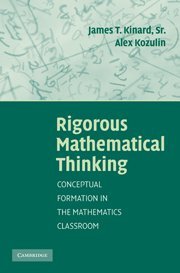
Rigorous Mathematical Thinking Conceptual Formation in the Mathematics Classroom 1st Edition by James Kinard, Alex Kozulin ISBN 0521700264 978-0521700269

Original price was: $50.00.$35.00Current price is: $35.00.
Rigorous Mathematical Thinking Conceptual Formation in the Mathematics Classroom 1st Edition by James Kinard, Alex Kozulin – Ebook PDF Instant Download/Delivery: 0521700264 , 978-0521700269
Full download Rigorous Mathematical Thinking Conceptual Formation in the Mathematics Classroom 1st edition after payment
Product details:
ISBN 10: 0521700264
ISBN 13: 978-0521700269
Author: James Kinard, Alex Kozulin
This book demonstrates how rigorous mathematical thinking can be fostered through the development of students’ cognitive tools and operations. Though this approach can be applied in any classroom, it seems to be particularly effective with socially disadvantaged and culturally different students. The authors argue that children’s cognitive functions cannot be viewed as following a natural maturational path: They should be actively constructed during the educational process. The Rigorous Mathematical Thinking (RMT) model is based on two major theoretical approaches allowing such an active construction – Vygotsky’s theory of psychological tools and Feuerstein’s concept of mediated learning experience. The book starts with general cognitive tools that are essential for all types of problem solving and then moves to mathematically specific cognitive tools and methods for utilizing these tools for mathematical conceptual formation. The application of the RMT model in various urban classrooms demonstrates how mathematics education standards can be reached even by the students with a history of educational failure who were considered hopeless underachievers.
Rigorous Mathematical Thinking Conceptual Formation in the Mathematics Classroom 1st Table of contents:
1 Culture of Mathematics
Sociocultural Needs Systems
Historical Evolvement of the Sociocultural Needs Systems
From Symbolic Thought to Mathematical Expression: Historical Footprints of the Mathematics Culture
Mathematical Learning Activity
Mathematical Knowledge
Need for Mathematically Specific Psychological Tools
Mathematical Rigor
2 Goals and Objectives of Mathematics Education
The Standards Movement in Mathematics and Science in the United States
The Need for Rigorous Thought in Mathematics and Science Education
3 Vygotsky’s Sociocultural Theory and Mathematics Learning
Mediated Character of Human Learning
Symbolic Tools and Their Internalization
Zone of Proximal Development
Learning Activity
Learning Activity and Math Curriculum
4 Mediated Learning and Cognitive Functions
Mediated Learning Experience
Development of Cognitive Functions
Cognitive Functions in RMT Paradigm
Instrumental Enrichment Program
IE Program as a System of Psychological Tools
Instrumental Enrichment and Math Problem Solving in Immigrant Students
Study 1
Study 2
5 Mathematical Concept Formation and Cognitive Tools
Mathematically Specific Psychological Tools
Symbols and Codes
Number System with Its Intrinsic Place Values
Number Line
Table
Cartesian Coordinate System
Mathematical Language
Standards-Based Conceptual Formation Through RMT
Conceptual Nature of Cognitive Functions
The RMT Process for Concept Formation
Strategic Planning to Teach Through the RMT Process
Conceptual Formation in Basic Mathematics Through RMT
Basic Mathematics Operations
Mathematical Activity A on Quantity
Mathematical Activity B on Quantity
Understanding and Comparing Fractions with Unlike Denominators
Conceptual Formation in Algebra Through RMT
6 RMT Application, Assessment, and Evaluation
Lesson Planning
Mediation During the Lesson
Assessment
RMT Program Research in Primary School
RMT Research with Cultural Minority Students in the Middle School
High School Dropouts
People also search for Rigorous Mathematical Thinking Conceptual Formation in the Mathematics Classroom 1st:
rigorous mathematical thinkingg
rigorous mathematical thinking conceptual formation
rigorous mathematical
rigorous mathematical definition
mathematical rigorousness
Tags: James Kinard, Alex Kozulin, Rigorous Mathematical, Mathematics Classroom