

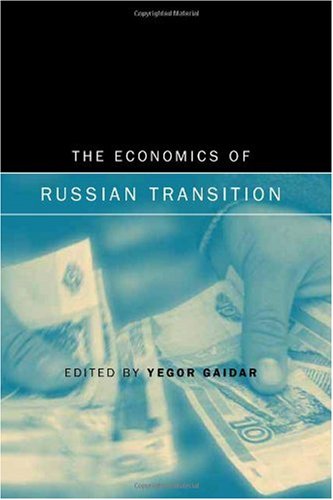
The Economics of Russian Transition 1st Edition by Yegor Gaidar ISBN 026207219X 978-0262072199


Original price was: $50.00.$35.00Current price is: $35.00.
The Economics of Russian Transition 1st Edition by Yegor Gaidar – Ebook PDF Instant Download/Delivery: 026207219X, 978-0262072199
Full download The Economics of Russian Transition 1st Edition after payment
Product details:
ISBN 10: 026207219X
ISBN 13: 978-0262072199
Author: Yegor Gaidar
Table of contents:
I. Preconditions for the Postcommunist Transformation
1. The Inevitability of Collapse of the Socialist Economy — Yegor Gaidar
1.1. Stability of the Socialist Economic System
1.2. Characteristics of the Socialist Model of Economic Development
1.3. Internal Constraints on Long-Term Development
1.4. Options for Reforming the Socialist Economy
1.5. Signs of Exhaustion of the Growth Model
2. The Logic and Nature of the Soviet Economic Crisis — Vladimir Mau
2.1. Reforms of Late Socialism
2.2. Ideology and the Reform Program
2.3. The Practical Problem of Improving the Economic Mechanism
2.4. Economic Crisis as a Crisis of the State
3. The Liberal Market Reform Program — Sergei Sinelnikov-Murylev & Alexei Uluykaev
3.1. The Range of Opposing Views
3.2. Debates on Achieving Financial Stabilization
3.3. Socioeconomic Situation on the Eve of Reforms
3.4. The Need to Accelerate Reforms
3.5. Russia’s Progress Toward Economic Independence
3.6. Essence of Socioeconomic Reforms in the Transition
3.7. Cutting the Budget Deficit
II. Macroeconomic Processes and Economic Policy of Postcommunist Russia — Main Stages
4. General Macroeconomic Problems of the Postsocialist Transition in Russia — Sergei Sinelnikov-Murylev & Georgy Trofimov
4.1. Financial Relations and Their Role
4.2. Predeterminacy of Economic Reforms
4.3. Price Liberalization as a “Shock”
4.4. Political Restrictions and Delayed Stabilization
4.5. An Unorthodox Version of Orthodox Stabilization
4.6. The Fiscal Crisis
4.7. Conditions and Factors of Economic Growth
5. Macroeconomic Stabilization as a Sociopolitical Problem — Vladimir Mau
5.1. Delayed Stabilization
5.2. Inflationists vs. Anti-inflationists
5.3. Changing Balance of Forces
5.4. Constitutional Problems of Macroeconomic Stabilization
6. Problems of Macroeconomic Stabilization at the Stage of Economic Liberalization (1992) — Sergei Sinelnikov-Murylev & Georgy Trofimov
6.1. Tight Budgetary Policy and Liquidation of Monetary Overhang
6.2. Populism and Weakening of Fiscal Policy
6.3. Monetary and Credit Policy in 1992
6.4. Attempt to Change Fiscal Strategy Without Coordination
6.5. Reconstruction of State Revenues and Expenditures
7. Formation of the Preconditions for Financial Stabilization — Sergei Sinelnikov-Murylev & Georgy Trofimov
7.1. Political Factors Affecting State Finances
7.2. Monetary and Credit Policy in 1993
7.3. Reduction of Expenditures After the 1993 Crisis
7.4. Reconstruction of the 1993 Budget
7.5. Slowing Fiscal Reforms: “Moderately Tight” Policy
7.6. Peculiarities of the 1994 Budget Process
7.7. Reconstruction of the 1994 Budget
7.8. Toward a Tight Fiscal Policy
7.9. Monetary and Credit Policy in 1994
8. Financial Stabilization in Russia — Vladimir Mau, Sergei Sinelnikov-Murylev & Georgy Trofimov
8.1. Political Preconditions
8.2. The Monetary Program for 1995
8.3. Budget Policy During Stabilization
8.4. Tightening Monetary Policy and Inflation Inertia
8.5. The Role of the Exchange Rate
8.6. Strengthening the Real Ruble
8.7. Crisis on the Interbank Market
People also search for:
describe the economic transition in russia
the russian economy a very short introduction
russian transition to capitalism
russia transition to market economy
economic transition of russia