

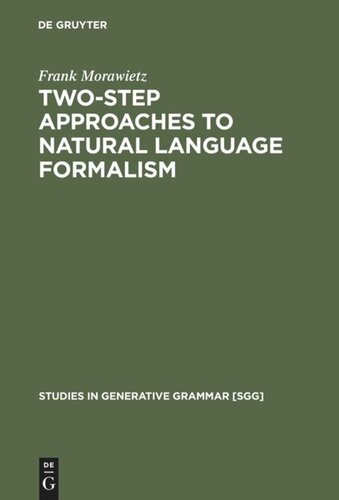
Two Step Approaches to Natural Language Formalism 1st edition by Frank Morawietz 3110197251 9783110197259


Original price was: $50.00.$35.00Current price is: $35.00.
Two Step Approaches to Natural Language Formalism 1st Edition by Frank Morawietz – Ebook PDF Instant Download/Delivery: 3110197251, 9783110197259
Full download Two Step Approaches to Natural Language Formalism 1st Edition after payment
Product details:
ISBN 10: 3110197251
ISBN 13: 9783110197259
Author: Frank Morawietz
This book presents a unified formal approach to various contemporary linguistic formalisms such as Government & Binding, Minimalism or Tree Adjoining Grammar. Through a careful introduction of mathematical techniques from logic, automata theory and universal algebra, the book aims at graduate students and researchers who want to learn more about tightly constrained logical approaches to natural language syntax. Therefore it features a complete and well illustrated introduction to the connection between declarative approaches formalized in monadic second-order logic (MSO) and generative ones formalized in various forms of automata as well as of tree grammars. Since MSO logic (on trees) yields only context-free languages, and at least the last two of the formalisms mentioned above clearly belong to the class of mildly context-sensitive formalisms, it becomes necessary to deal with the problem of the descriptive complexity of the formalisms involved in another way. The proposed genuinely new two-step approach overcomes this limitation of MSO logic while still retaining the desired tightly controlled formal properties.
Two Step Approaches to Natural Language Formalism 1st Table of contents:
I Introduction
1 Overview
1.1 Desiderata for a linguistic formalism
1.2 Logic, algebra and formal language theory
1.3 Outline
2 Technical preliminaries
2.1 Alphabets, words and languages
2.2 Trees
2.3 Algebras
II The Classical Approach
Using MSO Logic as a Description Language for Natural Language Syntax
3 Model-theoretic syntax and monadic second-order logic
3.1 Overview of the classical approach
3.2 Monadic second-order logic
4 Finite-state devices
4.1 Finite-state language processing
4.2 Tree automata
4.3 Tree-walking automata
4.4 Tree transducer
5 Decidability and definability
5.1 Representing MSO formulas with tree automata
5.2 Coding of relations
5.3 Constructing automata from MSO formulas
5.4 Finite model theory
5.5 Definability of relations in MSO logic
5.6 Definable MSO transductions
5.7 Terminology
6 Applications
6.1 Parsing with tree automata
6.2 Compiling grammatical principles to FSTAs
6.3 Approximating P&P grammars
6.4 Some experimental results
6.5 Further applications
7 Intermediate conclusion
III Two Steps Are Better Than One
Extending the Use of MSO Logic to Non-Context-Free Linguistic Formalisms
8 Overview of the two-step approach
9 Non-context-freeness of natural language
9.1 Minimalist grammars
9.2 Tree adjoining grammar
9.3 Linguistic motivation: verb raising
10 The first step: Lifting
10.1 Tree grammars
10.2 Lifting
10.3 Coding the lifted structures
10.4 Summing up the first step
11 The second step: Reconstruction
11.1 Reconstructing lifted (M)CFTGs
11.2 Reconstructing lifted MCFGs
11.3 Summary of the two-step approach
IV Conclusion and Outlook
12 Conclusion
13 Outlook
V Appendix
A Acronyms
B MONA code
B.1 XBar Theory
B.2 Co-Indexation
C Additional MSO Definitions
C.1 The MSO Definition of Intended Dominance
D Prolog Code
D.1 Apply a given MTT to a tree generated by an RTG
D.2 The Example Grammars
People also search for Two Step Approaches to Natural Language Formalism 1st:
natural language formalism
formal linguistics theory
syntax and semantics interface
computational linguistics models
logic and natural language
Tags: Step Approaches, Natural Language, Formalism, Frank Morawietz